

2,400 years later, Ancient Greek comedy takes the stage at USU
The Utah State University Theatre Arts Department brought a 2,400-year-old Greek comedy to the life at the Morgan Theatre in the Chase Fine Arts Center with its production of Aristophanes’ ” Thesmophoriazusae; or, What Women Want.”
Rehearsals began the first week of the fall semester after auditions last spring. The show opened Oct. 2 and closed Oct. 7.
The production follows the playwright Euripides, who learns that the women of Athens are furious about how he writes them, and the increasingly ridiculous lengths he goes to in order to save himself.
“I think it’s especially pertinent for today’s time,” said Grayson Jenkins, a sophomore in the musical theater program who performs in the Chorus of Men. “It ends with themes of feminism, of equality and honestly, just a respect for all parties, all people.”
Agathon, a real Athenian tragic poet, is played by sophomore Riley Thompson. In the play, Agathon is an up-and-coming playwright who serves as a foil character to Euripides.
“He’s kind of like in with the new, out with the old Euripides,” Thompson said. “He’s writing a new play about women and the Thesmophoria and the women’s experience. So he thinks to himself, ‘To really be able to write about the female experience, I need to live the female experience.'”
To do that, Agathon dresses in women’s clothes and, as Thompson put it, does his best to act like a woman. Thompson described it as the character’s version of method acting.
Thompson said stepping into such a big, comedic role did not come easily at first.
“If I’m being completely honest, it really was hard and pretty uncomfortable for me to step into the role in the beginning,” Thompson said. “I was really timid and really shy. I was really scared to step into it and just be bold and make big decisions.”
The turning point, he said, came when he decided to stop holding back.
“There was just a moment in the rehearsal process where I just told myself I just have to commit with everything that I have, and then everything will kind of fall into place,” Thompson said.
He credited the director, time spent playing around on stage and the costume, which he called “quite intense,” with helping him get there.
Making a comedy this old land with a modern audience took some work. Jenkins said the cast struggled with the text at first.
“At first it was pretty difficult to kind of understand the text, understand the story,” Jenkins said, “but with the work of Richie Call and Amanda Dawson, who adapted the script, they helped us to be able to tell it in a user-friendly way to help people understand the story and find comedy in something so old.”
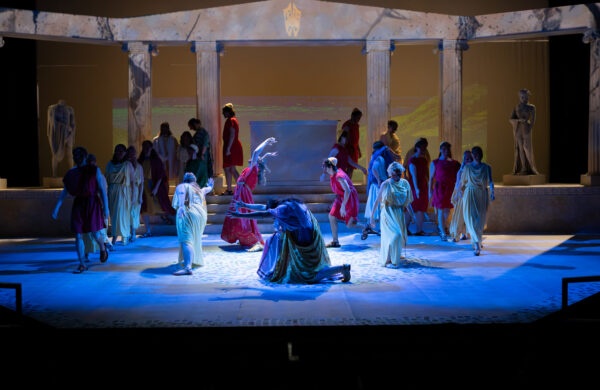 Dycie Jo Photography
Thesmophoriazusae; or, What Women Want
By Aristophanes
Adapted by Amanda Dawson and Richie Call
October 2, 3, 5, 6, 7 @7:30pm
October 3 @1:00pm
Morgan Theatre
One of the biggest changes was the addition of two professor characters who regularly stop the show to explain what is happening. According to Jenkins, those characters were not part of the original play. They were added so the audience could learn the story while watching it.
That meant the actors had to adjust to being interrupted mid-scene, night after night.
“It was hard to find the momentum to get back into what you’re doing,” Thompson said. “I feel like acting-wise, it made our job to be a bit more expressive to the audience, to be a bit more specific, so that they would understand what’s going on.”
Jenkins said the cast eventually leaned into the awkwardness.
“It caused a lot of confusion, but honestly, we decided to play into that confusion as kind of a comedic bit,” Jenkins said. “The audience eventually caught on, but at first it’s probably confusing.”
The production also gave students room to create. Partway through the show, the chorus performs a series of three-minute plays meant to show off Euripides as a playwright. Those short plays, based on actual plays written by Euripides, were all directed by students.
“We told the tragic tale of Medea through sock puppets,” Jenkins said, adding that the costume and props teams made the puppets on short notice.
Jenkins said Call, who he had worked with before in musicals, gave students a lot of freedom.
“He’s a very adaptable, very creative man,” he said. “He gave a lot of creative liberties to the students, and that was a really freeing and entertaining process.”
For Thompson, the heart of the play comes in its final scene, when the chorus of women finally tells Euripides what they have wanted all along.
“They don’t want money, they don’t want special treatment even,” Thompson said. “They just want to be written as equals and to stop being made complete spectacles by a man who knows nothing about the female experience.”
Thompson said the play challenges the idea that someone can portray a group of people accurately without having shared experiences. “I think a big theme in this is can you accurately represent a group of people whose experiences you don’t share?” Thompson said. “I also think a great thing that you can take from this play is how much power women have, especially when they group together, and their possibility to make change.”
Thompson shares his insight into how this can be related to modern day. “Working together and striving for change, especially in today’s society, still is something that we need,” Thompson said. “Not even in particular for women, but all minority groups.”
Jenkins said the play’s message comes down to appreciation.
“We’re all imperfect, but in the long run, it just comes down to appreciation,” he said. “Appreciating people for who they are and what they do.”
You must be logged in to post a comment.
There are no comments
Add yours