
43% tuition increase obsolete
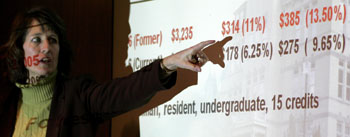
Students no longer need to worry about a 43 percent tuition increase, Noelle Cockett, interim provost said Tuesday at the Associated Students of Utah State University Executive Council meeting.
Tuition will still increase, but due to recent support announced by the state Legislature, the rise will not be as high, Cockett said. The main reasons for the original proposed tuition increase included faculty and staff salaries, the library, fuel and power, and operations and maintenance, among others. The Legislature recently announced extra funding for fuel and power and operations and maintenance.
“We want you to forget 43 percent,” Cockett said. “You don’t have to think of 43 percent ever again.”
The extra funding has allowed USU to lower its Tier II increase. Originally USU was planning on a state enforced Tier I increase of 2.5 percent and the university decided on a Tier II increase of 11 percent, resulting in a 13.5 percent increase next year. However, the state announced a Tier I increase of 3.4 percent. The extra funding from the state has allowed USU to propose a much lower 6.25 percent increase in Tier II tuition resulting in a tuition increase of 9.65 percent next year, Cockett said.
The new revised tuition increase also allots $220,000 to student initiatives. The council passed a bill to use the funding to improve advising, create an intensive language training program for graduate students who teach and whose native language is not English, improve the counseling center and create a student selected investment fund.
The extra funding will provide temporary advisers during busy times of the year and a peer-to-peer mentoring pilot program as well as hire an additional psychologist and psychiatrist for the counseling center to meet the growing needs of students. The intensive language training program would hire English speaking undergraduates to help graduate student teachers with their English.
“There is a lot of concern about the language barrier between the teachers and students and how it affects the quality of learning,” Jake Bonham, natural resources senator, said.
The student initiative bill also asked for extra funding from the Provost Office to hire more math tutors, improve and extend wireless internet on campus, improve the technology and equipment in the Career Services office and make the football stadium available for intramural sports.
The Executive Council also supported a new bike policy that would allow bikes on campus at all hours, but enforce state laws that allow police officers to give warnings and citations to careless bikers.
“This is a pedestrian and bike friendly policy,” ASUSU Student Advocate Al Lambert said.
The old policy didn’t allow students to ride their bikes in-between classes or in certain zones and was unreasonable and to hard to enforce, USU Chief of Police Steven Mecham said.
The council discussed in detail a proposal to close the Registrar’s Office to graduation needs during the first week of school and only tend to registration needs. The proposal would curb the problem with long lines during the first week of school, Heidi Beck, associate registrar, said. The council was split on the issue, but the proposal eventually passed with a vote by ASUSU President Les Essig as a tie-breaker.
Concern was raised as to the graduation application deadline and late fee. The deadline is determined by the advisers and thus hard to change, Beck said, but it is possible to eliminate the $100 late fee.
A bill was also passed giving money to the USU recycling department to place recycling bins in all campus housing.
-hilaryi@cc.usu.edu