
43% tuition increase proposed
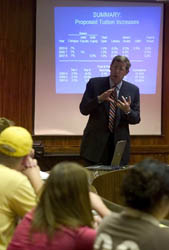
President Hall made a proposal to increase tuition 43 percent over the next three years at the ASUSU Executive Council meeting Tuesday.
A portion of the increase, 7 percent, will come from projected state-wide tuition increases required by the state legislature, with the other 36 percent going to fund what Hall presented as Utah State University’s top priorities.
The 43 percent increase will equate to about $1,126 for resident undergraduate students and will equate to about 12 percent increase each year.
Hall said the rise in tuition is necessary to allow USU to maintain quality education, even while funding from the legislature continues to drop.
“What is most important is that you leave here with an increasingly better education. I wish I could tell you there was a way to do that without needing more money; but when the state takes its contribution out, you’ve got to find some way to replace that,” Hall said.
Hall said USU tuition is currently at 67 percent of average national tuition costs with the proposed tuition increase raising that number to 76 percent of average tuition costs – an amount Hall said is still extremely low.
“We see nothing in what we’re doing that will make us less competitive on a pricing front,” Hall said.
Hall, responding to a question posed by a member of ASUSU, said he does not expect to see large decreases in enrollment due to tuition hike.
The priorities Hall presented to ASUSU included increasing faculty salaries, reducing the $5.8 million deficit in the fuel and power budget, continued funding of the libraries, increasing funding for operations and management, and putting more money towards selective investments.
Increasing faculty salaries is important, Hall said, because it means better retention of top professors and faculty. “We need to do some things to retain our best and strongest faculty,” he said.
Hall said USU probably has the worst faculty salary compressions in the nation.
Stan Albrecth, executive vice president and provost, said last year alone, USU lost 35 faculty members.
While USU has become more and more fuel efficient every year, Hall said, rising fuel costs and lack of legislative money have led to a $5.8 million deficit in the fuel and power budget; a problem Hall said he hopes will soon be addressed by the legislature but must be managed through other funds in the
meantime.
Currently, USU does not have a research library that ranks in the top 120 in the country, but continued funding of the current library project will insure that changes, Hall said, and USU cannot achieve its goal of having an “academics-first” institution without having a library that meets high standards.
Hall said other forms of funding were extensively looked at in addition to state money and tuition, but those efforts were unable to secure funds needed.
Those included private grants, which Hall said were not sufficient for general needs, because most private donors specify in advance which programs are to receive the gift.
Raising prices in auxiliary organizations, such as the bookstore, was also considered, but due to the self-sufficiency and competitive market those entities are involved in, was not an option either.
Hall said it is important to remember that he was asking for increased
tuition to fund necessary current operations of the university and not new or unnecessary projects”such as “domed football stadiums.”
Justin Rees, a representative of the Aggie shuttle system also presented a proposal to ASUSU that would allow them to pay for advertisement spots on the buses. Rees said the cost of 25 spots for one year, and access to the Plexiglas windows behind the drivers’ seats, would be $2,400.
Rees said the cost of advertisement being offered to ASUSU was discounted greatly compared with the price charged to private companies and even other university auxiliaries such as the bookstore and the athletics department.
Rees said the idea was in the best interest of everyone involved, saying that as a student he could think of no better use for funds than being kept informed of what is going on.
“There’s nothing more frustrating than planning an activity that no one comes to,” Rees said.
Both Tagg Archibald, ASUSU executive vice president, and Les Essig, ASUSU president, said they felt it was unfair to charge students for advertisement of activities on a bus system they were already providing 85 percent of the funding for.
The proposal was removed for discussion by the council so the matter could be looked into further.
Also at the meeting, Assistant Provost Sydney Peterson announced that beginning this year, December commencement will be held. This year’s ceremony will take place in the Spectrum on December 18th at 10:30 a.m. The new ceremony wasn’t expected to be initiated until 2006, but this winter’s ceremony was recently approved.
Peterson expects about 1,000 students to participate this year. Because of late notification, Peterson said, late application fees for this December’s commencement will be waived.
ASUSU also approved funding Rachel Hickman, new sexual assault and anti-violence coordinator $300 to help offset costs for this week’s Red Zone activities, including the inflatable features seen in the Taggart Student Center.
Initially, there was some debate over whether to award Hickman the money because bill sponsors had failed to provide a detailed financial breakdown of the requested money, but the bill passed with a 13-1 vote after about 30 min. of discussion. Three members abstained from voting for the bill.
Alyson Lambert, ASUSU student advocate vice president, said that any money put towards making Red Zone week activities more visible to students would be money well spent.
-bnelson@cc.usu.edu