
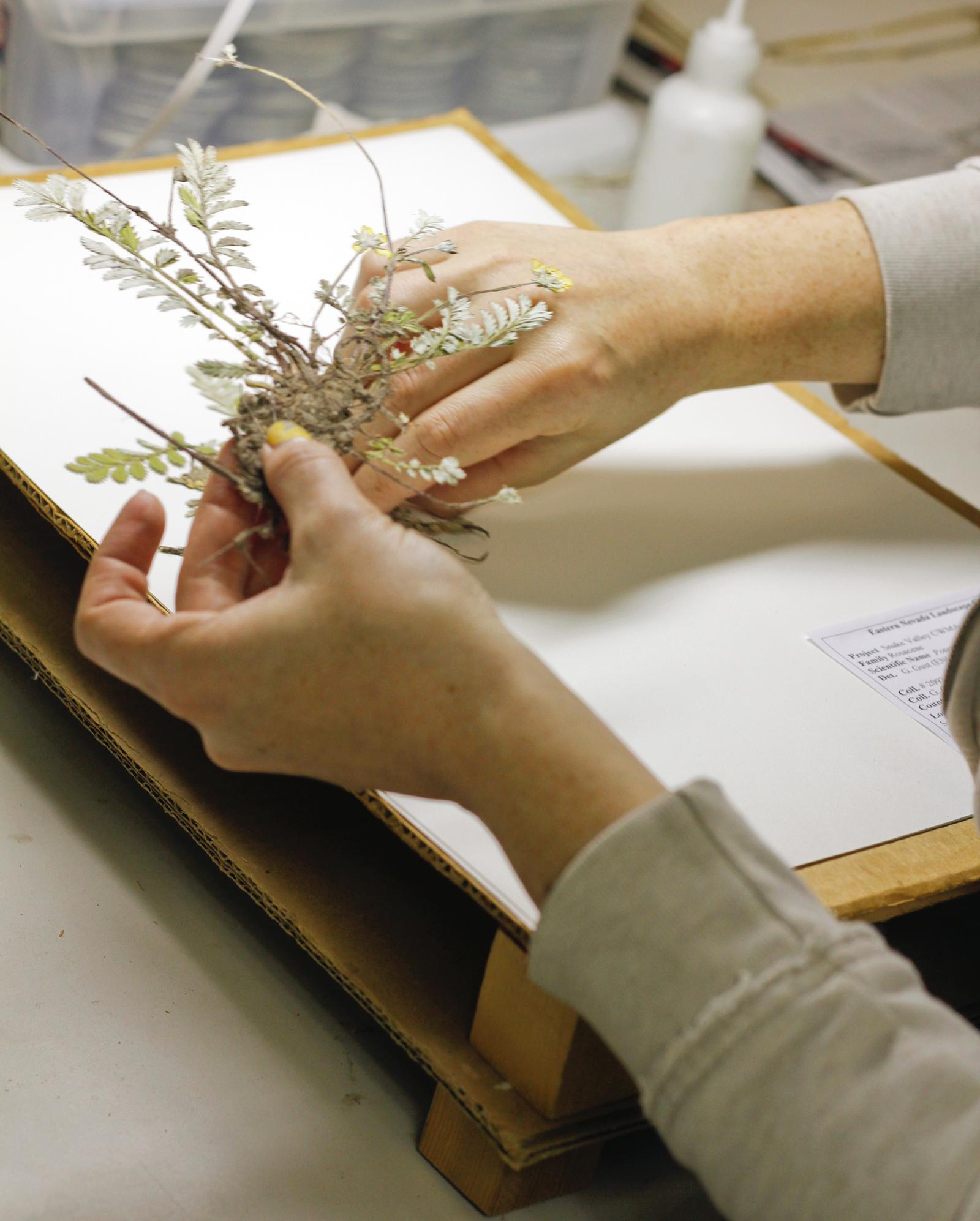
Intermountain Herbarium lends inmates a helping hand
Documenting plant specimens gives Daggett County inmates a project and purpose to work toward. Sara Lamb, Daggett County Jail GED teacher and USU Intermountain Herbarium volunteer, and Mary Barkworth, USU Intermountain Herbarium director, have been working together with the Daggett County Jail inmates to re-catalogue the 4,000 plant specimens.
The samples were donated by Tim and Sally Walker, a retired couple from Arizona.
“Why would anybody want 4,000 specimens in their home?” Lamb said. “What would you do with them? After dinner would you just flip through them?”
The Walkers own an online seed business and used the plants as a reference to show where the seeds really came from. Unfortunately, most of the catalogued plants don’t include the roots because the Walkers only had use for the part of the plant that produced seeds, Lamb said.
There are other problems with the samples as well.
“Our problem was this paper is not archival,” Barkworth said. “Herbarium specimens can last 500 years but we would like them to last 1,000. The worst thing is if these are not kept on archival paper because they’ll get brittle with age.”
“It’s the same with the glue,” Lamb said. “The specimens are just hanging there so we have had to glue them with this herbarium glue and hopefully it lasts as long as the paper.”
The largest concern for the herbarium is the archival quality, which is what the inmates have been helping with.
The inmates are really taking pride in cataloguing the specimens. To them, it’s not just a break in the routine or a way to earn pocket money, Barkworth said.
“I mentioned a little bit of the new project we are trying to do and the inmates said ‘Oh how exciting, I want to learn more, I want to learn something,'” Lamb said. “Some of them honestly have an interest in gardening and botany and they are just really excited that maybe we’ll even get the greenhouse, the Hoop House, up and going.”
A grant is needed to make the new Hoop House vision a reality are the Daggett County Jail. The Hoop House would be an outside garden on the jail premise where inmates could grow vegetables for the cafeteria to use in their meals.
One of the prisoners released last week hopes to enroll at USU next fall, Lamb said. She hopes working with the herbarium and documenting the specimens will help him feel confident about the skill sets he has learned and will stay out of jail.
“He told me in a quiet moment and said, ‘Sara, I am really scared to get out,'” Lamb said. “And I said ‘Why? Why are you scared?’ And he said ‘Because I got to have a whole new life, I have to have new friends, I have to have new habits, I have to have a new environment because if I don’t, I’m afraid I’m gonna get hooked back into this and I’ll be back in the system.'”
Lamb said the program with the herbarium and going to school while in jail is what helps inmates develop life skills and a feeling of importance so they can stand on their own once they are let back into society.
The inmates are about 95 percent done cataloguing the Walker collection, Lamb said.
“The neat thing about this collection, the Walker collection, is that the herbarium didn’t have some of the family members, the specimens from particular families,” Lamb said. “It’s really been an asset even though when we first looked at it we thought what are we going to do with 4,000 specimens? But to know that this is going to provide some specimens that we don’t have, that’s exciting.”
– rachel.lewis@aggiemail.usu.edu