
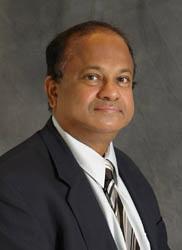
Professor honored for scientific advancements
Krishna Shenai, a member of USU’s electrical and computer engineering department, has been named a Fellow of the American Association for the Advancement of Science, AAAS, because of his extensive work with high-frequency, solid-state electric power management technologies and applications.
Shenai was nominated by other members of AAAS, a non-profit, international scientific society that offers fellowship to elite members who actively enhance the field of science and contribute to society.
“It is such an honor to become a fellow because you are nominated by your peers around the world. I am fortunate to be a member of such an exclusive club,” Shenai said.
He has been a member of AAAS for more than 20 years.
AAAS Fellows is a tradition that began 133 years ago. There are 24 sections of AAAS, and in order to be considered for the honor of becoming a Fellow, one must be nominated by the steering groups of the sections, three other fellows or the AAAS chief executive officer.
A council reviews the nominees and their achievements and then votes on the respective candidates.
Lonnie Shekhtman, communications officer of AAAS, said, “We nominate people in the organization who work to advance science throughout society nationally and internationally.”
Shenai said he was nominated by three other AAAS Fellows.
“I was nominated for not just one aspect. I was nominated for my research, my contribution to the economy evident from the results of commercially successful products that I developed, my teaching in academia and also for the companies I have started,” Shenai said.
This year, 449 members of AAAS were honored.
Shenai will be honored by the AAAS on Feb. 17, in San Francisco where he will receive a certificate and rosette pin for his contributions to the field and association.
USU President Stan Albrecht also praised Shenai for his pioneering efforts.
“Dr. Shenai’s work in electrical engineering compliments some of USU’s strongest competitive advantages. This honor of becoming an AAAS Fellow not only enhances Dr. Shenai’s resume but also our nationally renowned engineering program and Space Dynamics Laboratory. We’ll see some great ideas and technologies coming from this program in the near future,” Albrecht said in
previously published information.
Shenai came to USU in May 2006 as the first USTAR, the Utah Science, Technology and Research Initiative, professor. USTAR funds facilities and research personnel at USU and the University of Utah in hopes of generating new technologies, businesses and employment.
Recruited as the first USTAR tenured professor in Utah, Shenai said his three main responsibilities are to generate research funds from outside the university, creating intellectual property (patents) and creating high-technology jobs within the state to fuel the economy.
“He has co-founded three high-tech startup companies and consults for major corporations around the world. Those are qualities that will help him achieve the aims of USTAR,” Brent Miller, vice president for research at USU, said. “Dr. Shenai’s academic reputation is excellent, but he stands out because of his experience in technology commercialization. Shenai holds 15 issued patents and 10 pending patent applications.”
Shenai said his work at USU centers around wireless sensors and networks, electric power management technologies and low-power Microsystems whose applications include agriculture, healthcare, electric utility, space and defense, renewable and alternate energy, transportation, computing and communication.
He also teaches courses at USU.
Shenai said he is also helping the university to establish international collaboration in research and education.
“I’m not just sitting here and teaching. We are going global, and I am actively involved in that,” Shenai said.
He said they are specifically focusing on partnering with India and China because they are two of the largest emerging economies in the world.
“This is a great university,” Shenai said. “There are lots of opportunities for USU. Not just here, but globally. I am excited to be here and make that happen for USU.”
Shenai said he is a fellow of the Institute of Electrical and Electronics Engineers, IEEE, as well.
He has written and co-authored four books, 10 book chapters and 300 peer-reviewed technical papers.
In 1986, Shenai received his doctorate in electrical engineering from Stanford University.
Prior to his work at USU, Shenai worked at the University of Wisconsin-Madison and at the University of Illinois-Chicago as a professor of electrical and computer engineering.
He has also held senior positions at GE Corp. Research, Intel Corp. and COMSAT Labs.
-ariek@cc.usu.edu