
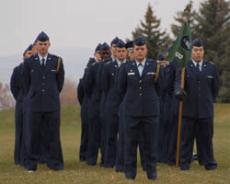
Female cadets learn to lead in Air Force ROTC
Air Force is not the place for girls.”
However, students in the core say the reality of their experiences are very different than the stereotypes. “The cadre [the senior officers and instructors in the core] is always open to help [the cadets] out,” said Kizna King, a freshman in aviation technology.
The Air Force ROTC (Reserve Officer Training Corps) is a training program designed to train commissioned second lieutenants in the active Air Force. Similar to the regular enlisted core, they are trained in Air Force history, strategy and Department of Defense policy, as well as general knowledge of Air Force workings. However, unlike the standard enlisted core, their training focuses on the leadership skills that will make them effective officers in the field. Upon completion of ROTC, they will receive their commission as an officer and be a leader over sometimes more than 100 other people in the field.
The entire experience of the ROTC is designed to help the cadets prepare to be officers in the field. The ROTC detachment is structured the same as active duty, with each leadership position filled up with upperclass ROTC students. Additionally, each cadet has different jobs that both help to keep the detachment running effectively and prepare the cadets for future jobs in the field.
During the first two years, the “followership,” they focus on learning the duties and general knowledge of the Air Force, with the cadets increasingly taking on more leadership responsibility, said Kara Clark, a sophomore in mechanical engineering. The upperclassmen serve as advisers for the newer recruits, as well as serving as the leaders for the detachment with the guidance of the cadre. Jen Friedel, a junior majoring in exercise science, is currently a squadron commander in charge of three other cadets – supporting them in their duties and follows up on their progress.
In addition to their ROTC demands, the cadets have full class schedules since an emphasis is placed on academic work. “If you don’t get the parchment, you don’t get [officer’s] bars,” Friedel said about the core requirement of the completion of a bachelor’s degree before they can become an officer.
Although females are a large part of the Air Force – comprising about 20 percent of the active soldiers – and the Air Force ROTC, they are still greatly outnumbered. In the USU Air Force ROTC, there are seven female cadets, compared to more than 60 male cadets. Despite the gender gap, Clark said that male cadets have been very respectful and that the cadre is “just as encouraging to females and males.”
Lt. Col. Michael Swift said that they “do not treat the females differently than the male cadets, but they do have different needs [such as a different dress code] and a different physical fitness standard.” But other than these slight differences, he said, “as for leadership opportunities, classes and everything else, they are part of the core and do everything the male cadets do.”
Swift also mentioned that the USU detachment has one female cadre member, Capt. Kirstin Plagge, who is an active officer. Swift says it is “good for males to learn about and interact with female officers.” Sarah Burningham, a junior in mechanical engineering, added that Capt. Plagge is helpful with answering questions that many female cadets have about life in the Air Force.
Because there are fewer females than males, they “depend on each other a lot more,” said Sarah Burningham. “Females form their own little team,” added Clark. Swift applauded the female cadets, saying they “do a super job … and are a vital part of the core.”
Despite the challenges of the core, the cadets agreed that the commitment is worth it. Burningham said the experience of learning leadership skills “has helped me in being a more confident person, learning to respect and love others, and pushed me to reach for high standards.”
-tliljegren@cc.usu.edu