
Air quality a problem again
A harsh winter in Cache Valley could mean non-compliance with the Environmental Protection Agency’s national air quality standards, resulting in sick residents and potential government mandates.
Scientists at the Utah Department of Air Quality monitor the presence of pollutants known as Particulate Matter 2.5 (PM 2.5) in the valley’s air. These pollutants are extremely small, about one 40th the diameter of a strand of hair, according to information from the Bear River Health Department. The EPA’s national benchmark of 65 micrograms of PM 2.5 per cubic meter requires that the valley’s three-year average be at or below the standard.
“We’re really close to exceeding that standard,” said Grant Koford, an environmental health scientist with the Bear River Health Department.
The harsher the winter, the worse the air gets as high pressure systems trap cold air in the valley. With no way to heat up and rise to the top, the air remains stagnant and pollutants continue to accumulate.
“Everything that goes in the air stays there,” said Jay Price, an intern at the Bear River Health Department and a graduate student at USU.
Such was the case in January and February of 2004, Koford said, when the area received national attention for its poor air quality. 2005 and 2006 have been better years, but to offset the extremely polluted winter of two years ago, Cache Valley can only have three more poor air quality days in 2006 before violating the EPA’s standards. No area in Utah has exceeded the PM 2.5 standard before, though Cache Valley has come the closest, Koford said.
“For the next two months we really want to stay within attainment,” Price said.
Exceeding the EPA’s standard could result in mandatory emissions testing with taxpayers footing the bill, or government imposed implementation programs.
Poor air quality doesn’t just mean low visibility, it can result in serious adverse health affects, causing damage to both the respiratory and cardiovascular systems, Koford said. The main problem stems from the microscopic size of the pollutant. Because a single particle of PM 2.5 is so small, the body’s cilia in the nose and throat can’t prevent it from entering the lungs.
“These particles are so fine that they penetrate very deeply into your lungs,” Price said.
Originally from St. George, Price said he became very concerned with air quality in Logan because he rides his bike nearly 365 days a year, and pollution has a very negative effect on his lungs and heart.
Persons most susceptible to the health risks of PM 2.5 are children, the elderly and especially people who already suffer from respiratory problems like asthma.
The most challenging aspect PM 2.5 poses to scientists and residents alike is that people have relatively little control over it.
“It’s so dependent on the weather,” Price said. “So much of it we have zero control over.”
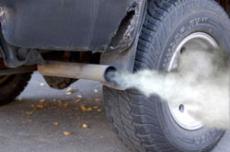
Price said that fact makes the little control residents do have all the more important. Because the majority of PM 2.5 comes from automobiles, the best thing people can do for Cache Valley’s air quality is to reduce the miles they drive.
“It’s a behavior change that we have to look at and that takes time,” Koford said.
Various education campaigns have been initiated this year to inform people of the dangers associated with poor air quality, and to tell them of the difference they can make.
If every person in Cache Valley were to not drive their car for one day a week during the winter months, pollution would be reduced by an estimated 375,000 pounds, Price said.
Koford said the Bear River Health Department has contacted every high school student council in Cache Valley, including some in Idaho, to ask students to carpool or ride the bus during the winter months. The public transportation company LTD will contribute a trophy to the school with the most carpoolers as an incentive.
USU has also been cooperating as it voluntarily purchased vehicle emissions testing equipment a few years ago to check all of its vehicles with, Koford said.
“It’s been really nice to have them on board,” Koford said.
An air quality committee was recently organized at USU under the direction of Price and natural resources Sen. James Stuart. The organization’s goals are to educate students of the ways they can help improve air quality, including launching an “anti-idling” campaign to discourage people from leaving their cars running when waiting in the lanes near the Ray B. West building and Edith Bowen lab.
“It’s everybody’s problem, and everybody needs to try to solve it,” Koford said.
mof@cc.usu.edu