
Pumpkin Attack
Sometimes technology improves things, sometimes it doesn’t.
When it comes to USU’s competition for catapulting pumkins, simple man-madestrength prevailed. All told, five teams participated in the eventsponsored by the college’s Institute of Electrical and Electronics EngineersClub.
USU students Nathan and Alden Jack built their catapult out of bailingtwine and tree limbs for a more natural-looking catapult.
“We used to build these in scouts,” said Nathan Jack, Vice Chairman of theIEEE. “We made them to launch water balloons.
The catapult might be ideal for water balloons, but it had a hard timelaunching the eight-pound pumpkins. Their longest attempt only made it 48feet, compared to the winning distance of nearly 100 feet by fellowelectrical engineering major Josh Arrington.
Arrington took a different approach.
In what IEEE secretary Shelley Rounds called “the ghetto entry,”Arrington bought a bed sheet at Deseret Industries and got a friend tohelp launch the pumpkin by hand. No special contraption here, just alittle manpower. The two wrapped up the pumpkin, then grabbed oppositeends of the sheet before winding up and throwing it. In the end, thetwo’s throw and subsequent roll earned Arrington $100.
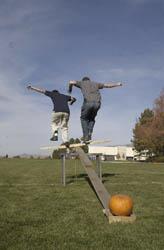
One of the more interesting entries of the day came from USU graduatestudents Brandon Boldt and Michael Mamanakis. The two used a 15-footboard resting on a sawhorse. On one end, the two placed the pumpkin. Theywould then jump in unison from the sawhorse onto the other end of theboard and launch the pumpkin high into the air.
Unfortunately for them, rewards were not given for the height of launch orfor entertainment provided to the approximately 40 spectators at theevent.
On the team’s test shot, the board snapped in two near the middle. Theyused a few spare nails to put it back together. After those ran out, thetwo resorted to anything else anyone had on hand.
“In the end our catapult was a strange mixture of boards, nails, maskingtape, bailing twine and frilly lace,” Boldt said.
While waiting for their turn, the two would practice jump synchronizationin hopes of not snapping the board again. Even with the practice, theirlaunch could not beat out Arrington’s throw as they finished in secondplace.
A similar event in 2003 pitted the College of Engineering against theCollege of Humanities and Social Sciences. That event saw the College ofEngineering narrowly defeat the College of HASS, 72 feet to 71 feet. Theevent had not been held since, though IEEE President Jana Coakley hopes tomake it a yearly tradition.
“We made pretty much no rules,” said IEEE Treasurer Heber Green before theevent. “You could bring an air cannon or even just throw it.
Throwing it appeared to be the way to go.
IEEE is a nation-wide organization of both students and professionals inthe field of engineering and electronics. USU’s club has approximately 80members, Coakley said.
-jcox@cc.usu.edu