
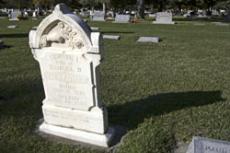
800-900 shovel scoops per grave
While approximately 14,000 students attend USU in Logan, another 19,000 permanent residents are buried in Logan City’s Cemetery – square in the middle of campus.
Students rightfully feel outnumbered by those residing 6 feet underground.
Of course, the old adage “6 feet under” might be a bit overused and slightly inaccurate.
“It’s really 5- to 5 1/2-feet deep,” said Roger Douglas, a grounds maintenance worker at the Logan City Cemetery who helps dig all of the graves.
Douglas or one of the other cemetery employees uses a backhoe to dig the
4-foot by 8-foot hole. On average, they dig more than 200 graves a year for the cemetery, he said.
The process of digging depends on where the grave is, Douglas said. On the western side of the cemetery, the soil is mostly sandy and easy to dig, but the east side is full of rocks, making the process take twice as long.
Occasionally, those digging the graves will find a few surprises.
“We find wood, tin cans, even a few slabs of concrete when we’re digging,” Douglas said.
At the bottom of the grave, Douglas and others place a cement vault that will
eventually hold the casket of the deceased. After the funeral, a cement lid weighing nearly 1,000 pounds is placed on top, he said. Then, they shovel back on the dirt onto the grave, compacting the soil several times in the process.
“That’s 800-900 shovel scoops per grave,” Douglas said. “With two people, we can fill a grave in 40 minutes.”
But filling a grave is a lot easier than digging it.
“It would take eight people two days to dig a grave back when they did it by hand,” Douglas said. Now the process takes anywhere from 20 minutes to a few hours, depending on the weather and soil condition.
Sometimes the graves are not even dug that deep. When children are buried, cemetery employees dig a grave three feet deep, Douglas said, noting the same depth is dug for cremations.
“We’ve buried cremations in urns, wood and even Tupperware,” he said.
One family chose to bury the ashes in the hole without a container and another spread the ashes on top of the ground without digging anything, Douglas said.
The choice of burial is always decided by the deceased and their families.
One grave even holds just a leg, Douglas said. The person continues to live, while their leg is buried in the cemetery.
“It’s just waiting there until they die and the rest of them is buried,” Douglas said.
Approximately 10 percent of all burials choose to be cremated, said Seth
Sparks, cemetery sextant. He anticipates that number will likely increase over time.
But finding space for burials is not a problem at Logan’s cemetery. Sparks estimates that more than 40,000 people could be buried in the cemetery if need be. If that number is exceeded, another proposed cemetery is under consideration on the east end of town, near the Logan Golf & Country Club.
If that move were made, it would mark Logan’s third official cemetery.
Before the current Logan Cemetery was constructed in 1865, residents were buried in a cemetery just below Old Main Hill, Sparks said.
“They got tired of sledding down the hill and running into headstones,” Douglas joked.
The real reason for the move was concerns over flooding issues, Sparks said. By moving the cemetery to higher ground, the problem was fixed.
More than 60 bodies were exhumed from the cemetery and moved to their present location in the Logan City Cemetery.
But in making the transition, apparently they didn’t get all of the bodies.
Decades later when construction projects took place in the area, one Logan family uncovered three additional bodies. They, too, joined the rest of Logan’s deceased in the town’s cemetery.
The current 53-acre cemetery is located just east of the Spectrum. On nearly every side, it is surrounded by university property.
It was established in 1865 and 23 years later, USU was founded. The two institutions have been neighbors ever since.
Students pass by the cemetery quite often. Some, like Kathleen Clayton, a sophomore majoring in excercise science, live on the northeast end of campus and walk through the cemetery every day.
“During the daytime, I think it’s beautiful,” she said. “But at night, it kind of creeps me out.”
-jcox@cc.usu.edu