
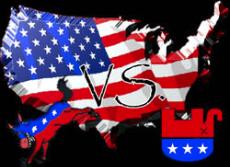
An endangered species?
Michael Lyons sums up the experience of being a Democrat in Republican-dominated Cache Valley in one word: “Lonely.”
Lyons, a professor of political science at USU and advisor to the College Democrats, said though he feels USU’s campus is fairly balanced politically, Democrats aren’t gaining any ground among the general population.
“I believe we are perceived as outsiders,” said Reid Pearce, chair of the Cache Democrats. Pearce, who is a Cache Valley native but spent 30 years around the country, said there is a “good combination” of people in the Cache Democrats who moved to the valley from other places as well as typical Cache natives.
With a growing mailing list of 6,000 and 400 to 500 active members, Pearce said the Democrats are slowly generating interest. He said party members go door to door to registered Democrats or those who are listed as unaffiliated and encourage them to get out and vote.
“We get a varied reception,” he said. “Sometimes they’re glad to see you and ask a lot of questions, sometimes they say, ‘Well, I’m a Republican.'”
He said while Logan has the highest concentration of Democrats in the valley, other, more rural areas are also home to Democrats.
One thing that makes politics for Democrats difficult in Cache is the overwhelming majority of Republicans, Pearce said.
“There’s a lot of apathy because there is not a 2-party system here. It stops a lot of people from voting,” he said.
Lyons said the degree of Republican domination may stop some people from exploring other political philosophies.
“If you ask most students [their political affiliation] they will probably say Republican rather than Democrat, because their parents are and they get the sense they ought to be,” he said. “There are a lot of students who label themselves conservative or Republican but who haven’t given it much thought or been exposed to the Democratic philosophy as Democratic party members would explain it.”
David Butterfield, chairman of the Cache County Republican Party, said he agrees that disinterest among voters is a problem in the valley. He said about 30 percent of Cache residents are registered Republicans, but many more identify themselves with the party. Such a majority lulls people into a false sense of security, Butterfield said.
“People assume a candidate is a good one if he’s Republican, or feel they don’t need to participate in the process because they know a Republican is going to be elected,” he said. “I think there’s danger in that attitude. I think people need to find out [a candidate’s] values, agenda and how he’ll vote on key issues.”
Though Democrats face the aspect of being a philosophical minority in an area high in ideological unity, Lyons said the fact that conservatives rule the roost isn’t a problem in and of itself – it’s that other parties don’t stand a chance.
“People sometimes describe Cache Valley as the happy valley where people are naive about the world. I don’t think that’s very accurate. It’s just not politicized,” said Lyons, who has lived in Logan for 26 years. “Elections aren’t interesting or competitive enough. It’s not healthy for students or for the political environment. I wouldn’t want to live in a place where Democrats dominate the way Republicans do here.”
Lyons said it’s not a surprise to most people that he’s a Democrat since he’s a college professor. He said the fact that there are more Democrats on USU’s faculty and especially in the political science department mirrors national trends. Since Utah is not politicized, Lyons’s guess is that there are probably more people who are apolitical than conservative in the state.
Lyons said he thinks a lot of people in Utah reject Democratic ideas too quickly.
“If people looked at where Democrats stand on issues of education and taxes and global warming they might not agree, but they wouldn’t dismiss it, either,” he said.
Butterfield said he doesn’t think people choose the Republican party by default, simply because it’s the majority.
“The majority of people identify with the traditional values of the Republican party, of small government and less taxation,” he said. “If you go out and ask people, that’s pretty much where they come down.”
–