
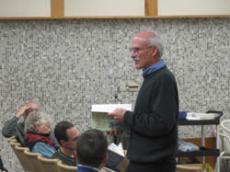
Nature writer and photographer speaks to students
The path that would lead Stephen Trimble to become a published nature photographer and writer of the dramatic beauty of the West began on the family road trips he took as a child.
His father’s profession as a researcher for the U.S. Geological Survey meant many hours of car rides and lots of story-telling, Trimble said Wednesday.
“My dad told stories as we drove through the West,” he said. “That had a powerful effect on me.”
The tales described the natural and human histories of mountain men and Lewis and Clark along with the history of the geography in the areas they traveled through.
For Trimble, nature writing and photography came about, well, naturally.
“It was just something I felt the need to do,” he said.
Having authored 20 books ranging from photo essays to children’s stories, Trimble has been writing for more than 30 years.
He spoke as part of the natural resources seminar series in Biology and Natural Resources Building Wednesday. He shared his life history with the approximately 75 audience members present and passed out copies of the books he has authored for them to browse through.
His childhood love for nature continued with him into adulthood, he said, as he became a park ranger after graduating in psychology from Colorado College in 1972. Trimble worked in Colorado and Utah, where he wrote 30-page brochures for parks like Arches and Capital Reef. Other rangers from national parks requested Trimble write their brochures.
“I kind of got a reputation,” he said.
Those brochures, along with work he did as an editor for the Museum of Northern Arizona Press, helped him get established in the publishing world and eventually led him to freelance writing and photography.
He shared his experience with curious audience members who wondered about the practicality of a freelance writer’s lifestyle.
While he said it’s possible to be solely a freelance writer and photographer, it’s sensible to do it as a side career, especially with the changes taking place in the publishing market.
“Writing has become more and more a business of conglomerates,” he said. “It’s wise to have a day job.”
The market for freelance photographers has also changed dramatically from the 1980s when Trimble got his start. Publishers now use the Internet to search from thousands of photographs rather than calling specific photographers.
The profession isn’t very conducive to family life either, Trimble said, as much time is spent waiting around for the perfect sunlight – a painstaking process that requires solitude.
“To have deep files from many places means you have to be on the road by yourself a lot,” he said.
To adjust, Trimble allowed his work to grow out of his own personal family experiences.
When Trimble’s two children were young, he would photograph them playing in brightly-colored T-shirts when on camping trips. He said the pictures sold very well in travel magazines and catalogues.
“I loved having small children and looking at the world through their eyes,” he said.
It was this time in his life when he wrote the book about childhood relationships with nature, “The Geography of Childhood: Why Children Need Wild Places.” It was an opportunity for him to be with his family and work simultaneously.
Other projects grew from his personal experience, including one book titled “Testimony,” which served to impact U.S. legislators. In 1996, a BLM wilderness bill that would set aside a number of acres as permanent wild lands was heard by the U.S. House of Representatives and the Senate. Trimble, along with the Sierra Club, was dissatisfied with the legislation because it designated few acres and was riddled with exceptions, including allowing power lines, he said. He compiled essays from various nature writers and distributed them to every member of Congress. When it came time to filibuster the bill, Sen. Bill Bradley read “Testimony” on the Senate floor. Pres. Bill Clinton said “Testimony” influenced his decision to declare Grand Staircase-Escalante a national monument.
Trimble said the impact “Testimony” had “gives me chills.”
“Each book travels out to its reader on its own,” he said. “Who knows how much difference they make, but they’re out in the world, circulating.”
Trimble held a book signing for his most recent work “Lasting Light: 125 Years of Grand Canyon Photography,” following his second presentation Wednesday evening.
His next project will be published in the spring of 2008 and has been 10 years in the making.
-mof@cc.usu.edu