
Fright Night offers a new Halloween view
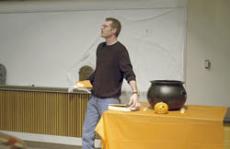
Phi Alpha Theta and the Residency Hall Association sponsored “Fright Night” Friday, featuring true stories of Halloween.
Julia Cunningham, the president of this honor society for historians, described the annual event, saying, “We used to bring in professor from the history department only, but lately we have started to branch out. This year, we brought in Dr. Tweraser, a German professor.”
Felix Tweraser started the evening out with some of Grimm’s Fairy Tales, including the story of “Aschenputtel” relayed in both German and English.
The story was made even more entertaining by the editorial comments offered by
Tweraser.
Aschenputtel was a very different tale than its sister story, “Cinderella.” No
fairy Godmother graced her with her presence and no pumpkin carriage carted
her to the ball, as Tweraser descrbed.
Three nights of dancing and gave the prince ample opportunity to ask her name,
but instead he followed her home. She always escaped in enough time to return
to her hearth and a wait the next night of revelry.
Tweraser then cautioned the listeners as the tale turned graphic, relaying
the gruesome methods the stepsisters took to force their feet into the tiny
slipper.
Ironically, the prince failed to recognize the fact that blood was soaking the
stocking and accepted each girl until he was told by two turtle doves perched
in a hazel tree that he had the wrong bride.
Even the conclusion was marred by the stepsister’s blinding by the birds
sharp beaks.
After Tweraser’s tale, Alice Chapman, a recent gradate of the University of Cambridge, took the stage and spoke on a medieval demon and a few haunted dwellings.
“‘The devil made me do it’ comes from the Titivillus, a patron demon of scribes,” Chapman explained.
Titivillus lurked around scribes trying to distract them from their important
work. Any misshapen letter or misspelling would be weighed against your soul.
“Aren’t you glad that all you get on your paper is red ink?” said Chapman, smiling.
She shared the evolution of this demon over the years, from the time when he
was quite powerful and filling his sack with the mistakes of scribes, to when he
resorted to writing down idle words in church for the scribes who were so careful
in their transcription.
Soon, though, with a spike in literacy, the scribes where rushed in their work,
increasing mistakes and Titivillus was again gaining strength.
By the later centuries, he had just become a general evil demon.
After relaying the tale of Titivillus, she then spoke of a few haunted dwellings
that she had visited and investigated and answered questions from the audience.
-skjohnson@cc.usu.edu