
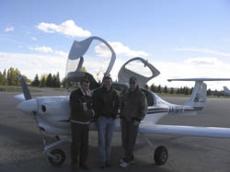
Flying Aggies cleared for take off
USU’s aviation program is flying a little higher after competing in a flight competition in Billings, Mont.
Ben Kaufman, Randy Fischer and Tom Scibelli from the program took one of the university’s new D-40 planes to compete in the National Intercollegiate Flying Association contest.
Kaufman, vice president of the aviation fraternity Alpha Eta Rho, said this is the first time the university has sent in a team in several years and they are making a goal to host the competition in 2008.
“This was a very good experience for the university,” Kaufman said. “The aviation program has entered a new chapter – new planes, new director, new students. This is a big step to get back into the collegiate field.”
The competition is designed to test the quality of training the students are receiving, Scibelli said.
While USU placed last out of the seven schools that were there, Scibelli said that was largely because USU had the least number of students participating and only competed in four of the nine events offered. Other schools brought three times that many students and competed in all the events, so they had more points. USU also only stayed for Tuesday through Thursday of the week-long competition that took place Oct. 13 through Oct. 20.
Kaufman said this competition is a big step for the aviation program. “We were flying planes that were 30 years old. Our equipment was antiquated,” he said. “Our director, Rick Charles, is taking that small regional school to be nationally acclaimed. Our goal was not to win, it was to establish a program so next year we can take a contingent of people.”
USU was also one of two schools at the NISA contest that had an active chapter of Alpha Eta Rho, Scibelli said.
“Our airplane outclassed every airplane by far,” Scibelli said. “We have state-of-the-art equipment and everyone was coming over and looking at it.”
Kaufman added, “As good as our equipment is, it’s the students that are raising the program to a nationally acclaimed level. Airplanes can only go so far.”
The three students competed in four different events, Kaufman said.
In navigation, the students are given a set of four coordinates and have to find a symbol that the contest officials have placed on the ground and then circle it in their plane.
Message drop has two students in the plane, with one being the pilot and the other the drop master. They have to try and drop an object in a barrel from 200 feet above the ground while going 100 miles per hour.
Pre-flight inspection has an airplane that is normally airworthy, but then the contest officials take the plane and create problems with it. The competitors are given 15 minutes to try and find everything wrong with the plane.
The final event was power-off landing, where the plane’s power must be turned off and then the pilot must try and land the airplane on a line on the runway. Student are judged on how close to the line they are, and disqualified if they are more than 100 feet in front of the line or more than 200 feet behind it.
“It was definitely a learning event to be prepared for next year,” Scibelli said.
The aviation program is self-funded and one of the least expensive in the nation, Kaufman said. He said USU students pay around $45,000 in fees for their training, while other schools pay anywhere from $100,000-$150,000, so USU is working with newer equipment and lower costs than the schools they competed against.
“These new airplanes are really nice,” Kaufman said. “From an outsider’s point of view, that’s the strength of the program. We believe the strength is the students who step up and represent the soul. This competition is just a venue for that to happen. USU better watch out for the Flying Aggies in a couple of years.”