
Military professors give views on teaching, war
Next time you raise your hand in class, sit up straight. Speak up. Say “sir.” Because you never know who could make you drop and do 20.
Though it may be hard for students to picture professors in any other capacity, many of them have actually led lives outside of the campus boundaries. For some of them, that includes serving the United States in the military. Often, that service has left its mark on the way they approach the classroom.
“I have a different perspective on issues such as grades and what the goals of a course should be,” said John McLaughlin, an associate professor in the English department. McLaughlin spent 14 years in the Army National Guard and the Army Reserves as an interrogation instructor. He said he was between units during Desert Storm and therefore wasn’t deployed, but he said whether or not people see combat, the military changes them.
“It makes me realize what’s important and what’s not,” McLaughlin said. “When you’re firing weapons at dummies in masks with faces, it gives you a different perspective.”
He said because of that perspective, he tends to run his classes on a pass/fail basis.
“It’s either ‘go’ or ‘no-go’ in the Army,” he said. “You either learn it or you don’t.”
Lyle McNeal, a sheep specialist and professor of animal science, has employed his military training in a variety of ways since he was hired at USU in 1979.
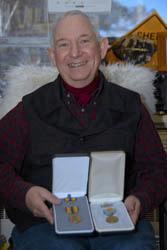
McNeal served as a U.S. Air Force pilot from 1957 to 1961, between Korea and Vietnam, and like McLaughlin, never saw combat. But in 1960 he was awarded the Medal of Valor for saving the lives of two fellow soldiers when he directed a search and rescue mission to find their downed plane in the Eastern Sierra-Nevadas during severe winter weather.
“Back in those days-it still is-but that was pretty remote,” McNeal said. He said he flew around searching for the men for 18 hours, stopping only once to refuel. He eventually spotted what looked like a message scrawled in the snow and directed the ground rescue to get them out. When the men were found, they had been outside for 50 hours and were hypothermic, but alive.
McNeal was also awarded a Meritorious Commendation for his actions in 1961, though he can’t remember for sure who awarded him either of the medals.
“I was just concerned with whether they were surviving, if they were alive,” he said.
Later McNeal continued to put his wings to good use when he came to USU. Before the days of satellite classes broadcast on television, he flew a group of professors to teach night classes in remote Utah locations once a week.
McNeal made the trips for 13 years but said some of the other professors could only handle it once.
“Some went one time and that was it,” McNeal said. “Some of the professors got nervous wearing oxygen masks. They got scared.”
McNeal said the oxygen masks had to be worn in the small Piper-Navajo because of the altitudes at which they were flying. “It’s a challenge, particularly going over the Uintas in the winter,” he said. “You’re dropping over 1,000 feet per minute.”
McNeal stopped flying in 2003 after he was forced to turn in his medical certificate after suffering a heart attack. He said he misses flying, but his military service is still evident in his everyday life.
“It taught me to be kind of meticulous,” he said. “It fits science.” And he said he expects the same from his students.
“I think there’s a time for respect.” He said he’s strict about cell phones and has no tolerance for any kind of cheating. “If I cheated in my flying experiences that wouldn’t be good; I could crash and kill people.”
“But I retain room for humor,” he added. “I have a saying, ‘That which we learn pleasantly, we retain.'”
Retired Gen. Mike Pavich, the president of the Space Dynamics Lab, said he agrees that military service-in his case, 29 years in the Air Force-can permanently affect performance in other arenas.
“Part of the military is learning leadership capabilities, people management skills, interpersonal relations, motivation techniques, mission accomplishment, pursuit of excellence,” he said. “If you are successful doing that in the military, those things carry over.”
Pavich graduated from the sixth graduating class of the U.S. Air Force Academy and flew 100 tactical reconnaissance missions over North Vietnam during the war. He also served as a squadron commander during the Cold War. He said his most rewarding military experience came during that time, when his 62nd Tactical Reconnaissance Squadron flew 62 training missions in 11 hours. He said the difficulty and accomplishment of the task were amazing.
“That was a very rewarding experience,” Pavich said. “The morale of the organization at the end of that was very high.”
He said he demands and receives the same level of efficiency now at his post at the SDL.
“I find the same kind of dedication at the Space Dynamics Lab and USU Research Station to mission accomplishment. It’s very parallel,” Pavich said.
And though their military experience has shaped the men in the way they live their lives, they are of independent opinions when it comes to President Bush’s proposal to increase troops in Iraq.
McLaughlin said he’s been against the war from the beginning and is against the surge. He said he wrote a letter to the Ogden Standard-Examiner six months before the war began, opposing the invasion of Iraq.
“I basically said, ‘If we invade Iraq, it’s going to be Vietnam in the sand,'” McLaughlin said. “I saw it as a kid in Vietnam; every week we’re going to send 20,000 more troops, and that’s going to solve the problem?”
He said his feelings about Iraq should not be confused with the war in Afghanistan.
“Afghanistan was perfectly justified. Those were the people that bombed the World Trade Center. We had a clear mission,” he said. “Afghanistan is the War on Terror. Iraq is George Bush’s personal cowboy.”
“This war had no end plan,” McLaughlin said. “It’s just this pie-in-the-sky, establish democracy and the Iraqis will govern themselves. You could copy and paste things they said in the ’60s to what this administration says now.”
McLaughlin said one of his biggest concerns is that the Guard and Reserve forces are not being used for their original purpose, which is to help in emergencies.
“The Iraq invasion was not an emergency,” McLaughlin said. “They’re being treated like active duty troops. The system is being abused.”
McNeal said he also feels that his former branch, the Air Force, has not been used properly in the war in Iraq.
“I would like to see them in Iraq use a little more, maybe, World War II sense,” McNeal said, which he defines as letting the military run the military. “They haven’t used the Air Force properly over there. I think they could have used the Air Force to save some of the ground force.
“I guess I don’t support the surge, not knowing what they’re going to do with it,” McNeal said. “I would like to see a little more responsibility on the Iraq government. I keep thinking what we need is a Gen. Patton.”
Pavich, however, was unwilling to criticize the proposed surge.
“We have a situation in Iraq that needs to be resolved to the benefit of the United States and our national interests,” Pavich said. “Now, there is debate over what those interests are, perhaps. The people that are in charge have the responsibility to determine what is going to be done to achieve those national interests.”
Pavich, whose son served a tour in the Air Force in Afghanistan and may be redeployed to Iraq, said recent criticism of the planned surge from both parties in Congress is “purely political.”
“Nobody has offered a better solution,” Pavich said. “I support the fact that the president of the United States has the authority to command military operations. The rest of the country just needs to get over it.”
All three men said they support the troops,
regardless of their positions on the war and the surge.
“I have a great deal of respect for our comrades over there,” McNeal said. “I think I learned the old duty, honor, country thing. It’s a brotherhood, and now it’s a sisterhood too.”
“They’re doing their job,” McLaughlin agreed. “This isn’t about the troops. And I think that’s one positive thing we learned from Vietnam. No matter how messed up the government is, no matter how messed up the policy is, we don’t blame the soldiers.”
After all, they were the soldiers once.