
Green beam making a summer comeback
After a two-year absence, USU’s famed “green beam” is expected to be running again sometime this summer.
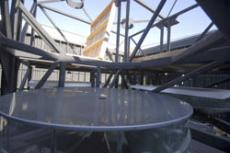
Used to measure atmospheric temperature, the Rayleigh Scatter Lidar is currently under construction. When completed, the system will be much larger. Its collecting area will also be greater.
“Right now it is just kind of in moth balls. We are in the midst of building a bigger system,” said Josh Herron, research assistant in the physics department. “The idea is that when everything is finished, we will also be able to measure the Doppler shift to measure wind in addition to the temperature.”
The Rayleigh Scatter Lidar will be 30 times larger than the original system when completed. With such an increase in size, the area of the atmosphere studied will be enlarged by 35 kilometers, Herron said.
The older telescope measures the temperature of the atmosphere located between 45 to 90 kilometers above ground. With the new lidar system, Herron said they will be able to begin measurements at 30 kilometers and extend to 110 kilometers.
“We take temperature measurements in the middle atmosphere, the mesosphere,” Herron said. “For a long time, nobody could take measurements there because it was difficult, so they called it the ignorosphere. It was in 1980 when they first made a lot of measurements.”
The system was first built in 1993.
“We are one of few universities around that studies the atmosphere in this way,” Herron said. “It will be essentially the largest in the United States or in the world.”
Using a series of telescopes, Herron said they are able to interpret the information about the atmosphere. The amount of light returned and collected by the telescopes is directly related to the density of the atmosphere.
“As the laser beam goes through the air, it scatters light. The number of particles of light is equivalent to relative density. The signal diminishes with altitude, so we have to use fairly large telescopes to get anything from 100 kilometers away,” Herron said. “Then there is some nasty math to calculate the temperature from the density.”
The Center for Atmospheric and Space Science then uses the data collected to study the behavior and temperature patterns of the atmosphere. That information, in turn, can be used to determine the magnitude of global warming.
Herron said, “If global warming is real, we should be able to determine that in this area of the atmosphere before it’s measurable on the ground.”
From atop the Science Engineering Research building, the beam can be seen four to five miles away and, to the human eye, appears to be one solid stream of light. However, the laser is pulsed, flashing 30 times per second. Each flash lasts seven nanoseconds, resulting in about a nine foot pulse.
Herron described the laser as very dangerous.
“One shot in the eye, and this laser can permanently blind you,” he said.
USU’s lidar system is funded by the National Science Foundation and the Air Force. Herron said the laser alone costs $160,000. A brand-new system costs more than half a million dollars.
Herron said the assembly of the new system has taken a long time because of a shortage in funding.
Gathering equipment and tools to aid in the construction has also slowed the process. Herron said they have been picking parts up piece by piece.
There are not many people who are actively involved in its construction, which has also delayed its construction. Herron said only he and a few graduate students have been working on the lidar system.
Herron works under the direction of USU Professor Vincent Wickwar. Wickwar was unavailable for comment.