
Finding spirituality through shamanism
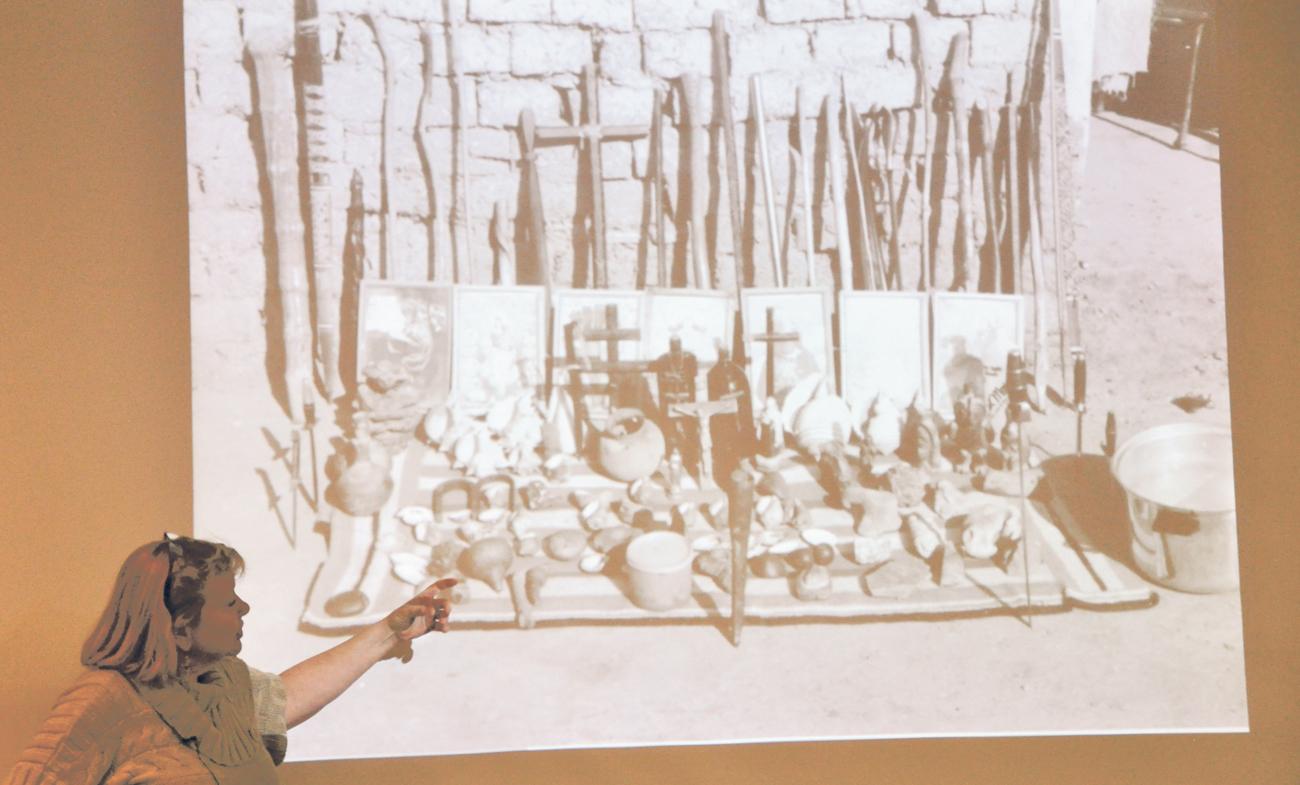
In this fast-paced world, many seek deeper peace through spirituality, meditation and religious devotion. For some, a course on shamanism offered by the anthropology department can expand spiritual knowledge. Bonnie Glass-Coffin, an anthropology professor, teaches such courses, including cultural anthropology, spirit and health, and shamanism.
Glass-Coffin said a survey was taken by the Higher Education Research Institute (HERI) in 2004 in which freshmen from public and private institutions were asked if they were religious or spiritual and if they considered this aspect to be a significant part of their lives.
Four out of five students and faculty described themselves as either spiritual or religious.
“Somehow it’s not OK to accept spirituality,” Glass-Coffin said. “It’s a historical artifact. Most students want more discussion on spirituality.”
She said the concept of liberal tought is about engaging in a plurality of ideas, which is another reason she teaches the course in a participatory way.
“When you’re doing a class about world religion, you have the sacred books of those traditions,” she said. “Shamanism is a tribally based orientation of experience between the spiritual and the divine. There are no books,” she said, adding that the models used are from the natural world.
“A shaman is a man or a woman, who is a healer and teacher who carries deep cultural knowledge and passes that on and helps his or her community by deeply engaging in the unseen world — the world of spirit,” Glass-Coffin said.
She was exposed to the realm of shamanism when she did a high school exchange program in Peru.
Glass-Coffin said the shamanism course is an experiment, but she is passionate in allowing students to experience spirituality in the classroom. She said the reason she does this is to challenge the paradigm used in higher education to discussions that involve students’ hearts as well as their minds.
Glass-Coffin said she read an article from a book written by Mary Polin titled “Finding Calcutta: Confronting the Secular Imperative,” that describes the great risk in academia of sharing personal and spiritual phenomena. According to Poplin, secularism in academia has become a hegemonic master narrative, in other words an overpowering rhetoric that limits free flow of spiritually based ideas.
“There is an interest in exploring — giving students the opportunity to engage their hearts as well as their minds — that is not being met by some of their classes,” Glass-Coffin said.
She invites any faculty and professional instructors interested in these issues to form a learning community where they will begin exploring the ethical considerations for having spiritual conversations.
The north Peruvian and central Andean based curriculum for the course follows the teachings of healer and teacher Oscar Miro-Quesada, who founded the Heart of the Healer foundation.
Glass-Coffin quoted Miro-Quesada, saying, “The most arduous, and the most important journey one will ever take is the 17-inch journey from head to heart.”
Recently, Glass-Coffin was a keynote speaker for the Women and Gender lecture series on women and spirituality.
She said spirituality is “an awakening to the spirit within, an acceptance of all life’s challenges, the paradox of surrender and action: choosing not to be a victim, an active engagement with everyday experience, empathy and compassion for others, leaving footprints fully living the gift.”
In her presentation, Glass-Coffin shared the idea of Anyi as a spiritual law as well as a law of nature: “It is at the heart of the principle that underlies the establishment of trust and mutual connection,” she said. “When we operate in the field of Ayni, we touch a frequency that allows for the possibility of deep connection and nourishment, as well as the possibility for synchronicity and miracles.”
Anyi is a healing practice in the shamanic belief.
According to the site Native American Shamanism, the practice is a system for psychic, emotional and spiritual healing and for exploration, discovery and knowledge gathering about non-material worlds and states of mind.
Yali Szulanski, co-founder of Sacred Warrior, a boxing, training and healing philosophy, said that shamanism found her.
“As I grow, I readily learn to accept and embrace the connection to the spiritual world,” she said.
Szulanski said her journey to shamanism began when she was 5 years old and she had recurring dreams in which spirits came to warn her of the void that would be left in her life from her father’s later disappearance.
“It was, at such a young age, a frightening and disturbing idea and set of images to be living each night,” Szulanski said. “But I began to understand the messages as things in my life shifted, and other such recurring communications came to fruition.” Szulanski said she has had communications with spirits around births and deaths in her family, as well as shifting events on a global scale.
She said she began to practice more than four years ago when she began to explore the help and healing of spiritual teachers and others who have had experiences with shamanism.
But she said she doesn’t claim to be a shaman herself, “I am still learning the intricacies of this communication and the delicate nature of the connection to the spiritual world.”
Tori Cattanach, a senior majoring in political science, decided to take Glass-Coffin’s shamanism class this semester because she needed an elective and found shamanism to be very interesting.
“I’ve thought about shamanism and I just wanted to see what it was all about,” she said, adding that she expects the class and practice will be intense. “We’re learning to do actual rituals.”
Tori’s brother, Ian Cattanach, a freshman majoring in philosophy, said shamanism is a practice of connecting oneself with the spiritual realm. Both students are taking the course this semester.
“It’s all about going into the spiritual realm instead of the physical realm that we’re in right now,” Ian said.
For the class, students purchase rocks, a feather and a meditation mat, among other necessities for the rituals.
Tori and Ian both said they bought some of their supplies at the Dancing Crane in Salt Lake City. The store offers pottery, candles, chimes, ethnic art, incense, jewelry and clothing.
Tori said she is taking the introduction to shamanism course to obtain a broader spiritual knowledge base.
“I like to learn about different religions and cultures, and I think this one is very interesting,” she said. “It’s the most ancient religion,” Tori said. In ancient times, there was a shaman in each tribe who held the role as spiritual leader and teacher.
In Glass-Coffin’s syllabus, students must agree to certain conditions, including: “I understand that psychic dismemberment, death and rebirth are integral to shamanic apprenticeship and initiation.
In Glass-Coffin’s syllabus, students must agree to certain conditions, including taking responsibility for their own participation. Shamanic apprenticeship, she said, most often requires a transformation in the way that initiates view themselves in the world. This is often referred to as “psychic dismemberment.” In her class, she wants students to be open to transformation and asks them to agree to hold the instructor and Utah State University harmless for any “psychic dismemberment” or personal discomfort that occurs as a result of my participation in this course.”
“I’m asking people to take that 17-inch journey from head to heart and be willing to deeply engage their own sense of purpose,” Glass-Coffin said.
Students interested in shamanism, spirituality or the conversation can get in touch with Glass-Coffin through her email at bglasscoffin@gmail.com.
– natashabodily@gmail.com
I’ve always been drawn to the spiritual aspect of conscious. I’ve felt others pain and joy, felt their energy flowing freely with mine and seen their energies at times. I’m in school for massage therapy now and want to increase my knowledge of healing but I definitely want to move beyond only physical healing. I also want to make progress in my own journey, to understand what I can do while in this life to live the best I possibly can and be the best I possibly can.