
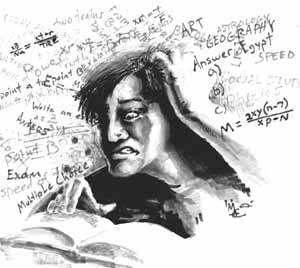
Test anxiety affects performance
The professor just finished handing out the exam. As the first question is read, an awful sinking feeling begins growing with every breath taken and the brain suddenly shuts down.
“Anxiety is a normal [and healthy] kind of experience,” Louise Welter, a psychology intern at the Counseling Center, said at a seminar about test anxiety. “Anxiety can actually help our performance.”
Along with Leticia Martinez, a psychology professor, Welter taught students how to overcome test anxiety and form better study habits.
Anxiety does interfere with performance, however, Welter said.
“Anxiety is the body’s response to something threatening in the environment,” she said. “[Our] perceptions are different from what’s going on.”
There is a physiological response that comes with anxiety. An adrenaline rush causes the hands to shake and the muscles in the body to tighten, the nervous butterfly feeling begins in the stomach, breathing becomes more abrupt and less effective, and the mind becomes distracted. This is the individual’s body talking to them, Welter said.
The body gives out these signs and the mind labels the signs with different meanings such as fear, happiness or anger.
If the hands are shaking due to lack of nourishment, the mind may interpret this response as test anxiety, which raise unhelpful thinking patterns, Welter said.
The student may begin to form dysfunctional thoughts in their mind discouraging thoughts, which interrupt the test. When these thoughts appear, the student should immediately clue into the big signal, or a red flag, she said.
Rather than thinking they are anxious, they should be thinking they are becoming anxious. That way, the student’s thoughts have not done any permanent damage and they can overcome the fear without adding more stress. It is easier to stop discouraging thoughts before they start, Welter said.
Coping thoughts are thoughts that help level the anxiety and performance of the student by helping him or her to feel safe, secure and relaxed, she said.
The body talk needs to be silenced. Studying for the exam long before the exam date can help silence the body. The night before the exam should be spent in relaxation. Going to a movie is a good way to relax, Welter said.
“In the context of relaxation and anxiety management skills – which are my areas of expertise – basic components of relaxation skills such as progressive relaxation, deep muscle relaxation and visualization can be learned in a single one hour session with a person experienced in relaxation skill training,” she said. “[However] relaxation skills must be practiced regularly for a person to become proficient in using them.”
At the Academic Resource Center [ARC], students can receive a pamphlet of some helpful hints when preparing for exams. One particular subject the pamphlet refers to is cramming for a test. As unhealthy as it is to pull an all-nighter, this pamphlet gives some strategies to help with last-minute studying and remaining relaxed during the exam.
“The staff of the Counseling Center and ARC are specifically trained in working with students to better understand the source of their difficulties,” Welter said.
The ARC is located in the Taggart Student Center, Room 305, and has a Web site, at www.usu.edu/arc/. Suggestions are given on how to prepare and relax before, during and after the test and it also has an eight-day study schedule for the student to follow, according to the Web site.
“Motivation is the primary factor in how long it would take to develop an effective study routine,” Welter said. “Other factors that could impact this process are the skills or attributes an individual already possesses, such as study skills; organizational skills; time, stress, and anxiety management skills; presence of a learning disability, ADHD, other mental health or physical difficulty; and previous academic skills and experiences.”