
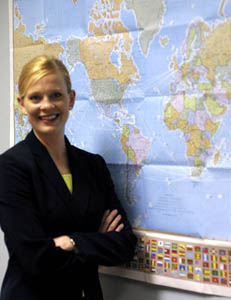
From USU to the CIA and back
Reading students’ papers on world cultures and politics may seem a long way from writing daily briefs for the president and U.S. defense secretary.
But, both are part of life for a Utah State University political science instructor. She remembers feeling as modest as any undergraduate early in her government career.
“You have to learn to accept things with grace because you are going to be wrong some of the time,” said Jeannie Johnson, a former intelligence and political officer for the State Department and CIA. “It is a real humbler.”
Johnson’s regional specialties on the former Yugoslavia comes from her experiences working for the U.S. government. She also conducts research on the Al-Quaeda terrorist network. She earned her bachelor’s and master’s degrees from USU and currently teaches in the university’s political science department.
“USU has a lot of assets,” Johnson said. “Students here get a lot of attention that they wouldn’t get elsewhere. Professors aren’t removed – the students matter. The faculty is constantly trying to offer students new opportunities. That is how I actually got involved with the CIA.”
Johnson was working as a USU instructor when she caught the eye of Larry Booth, a USU professor and CIA officer.
“Larry asked me if I had ever thought about the world of intelligence,” she recalled. “I told him that he was full of bologna.”
Johnson had worked for the State Department in 1995 as an intern at the U.S. Embassy in Paris. She reconsidered the CIA and began working for the agency as an intelligence analyst in 1998.
“Working for the CIA has put me at an advantage,” said Johnson. “I had intense peer support. I got to help my country and I have credibility with peers. There was stress, but it was enjoyable stress. It was the fast lane and I was contributing.”
The CIA isn’t all cloaks and knives, “there are a lot of nice people,” she said. The agency’s mission “is to get the accurate truth.”
She ended her government career with the State Department, working in 1999 at the U.S. embassy in Zagreb, Croatia, where she assessed local campaign strategies and coordinated democracy-building activities.
The work by the CIA is literally reflected in its formal name of Central Intelligence Agency, she said, meaning “all information comes there into a central spot” for analysis. Decisions stemming from the information, however, are made by other government agencies, such as the State Department.
Johnson said she did not choose her teaching career in political science, “it choose me.” She remembered an undergraduate political science class taught by a USU professor, who still teaches at the university.
“It all started with Mike Lyons’ introductory course,” she recalled. “I was engaged by the class. In high school I did debate and I liked to study law, so I just kept up with it.”
Her subsequent work for the U.S. government didn’t change Johnson, it simply “made her more confident,” said Randy Simmons, head of USU’s political science department. “She is one of the most gifted teachers I have ever seen, one who really knows her material.”
Johnson was named USU’s Teacher of the Year for Distance Education in 2004. Two years earlier, she received the student-nominated Gerald R. Sherratt Award for teaching excellence and student relations.
She retains contact with government agencies by attending conferences. She describes “keeping one leg in that exciting world” while staying in the more “rational world” at USU.
Johnson counts herself lucky, living only a few minutes away from campus. She is married to Steve Johnson, a man she characterizes as a wonderful husband. They are parents to sons Benjamin and Sam.
Among her strongest beliefs is political involvement. She insists that Washington listens, whether voters are informed or not, making it even more important for people to become educated.
“Ignorant or educated, both opinions count,” she said. “I want people to get excited about being informed.”
-amandawouden@cc.usu.edu