
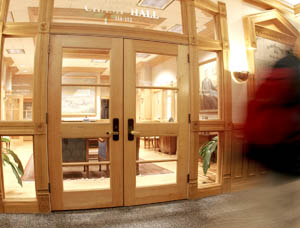
The Artifacts in Old Main
Using pre-historic pottery-making techniques of her Anasazi ancestors, Maria Martinez worked throughout her life to gel the differing worlds of archeology and aesthetics.
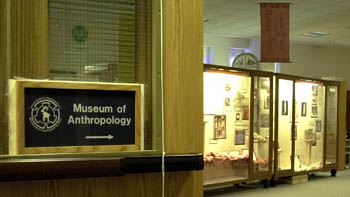
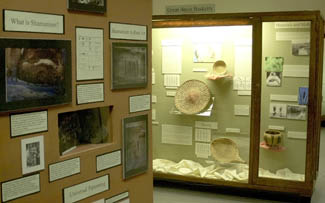
Beginning 5 p.m. on April 27, a year and a half of collaborative work between the Museum of Anthropology located on the second floor of Old Main, and the Nora Eccles Museum of Art will reach fruition as members of “Team Marie” unveil a new display centering around Martinez’s work and how it brought her New Mexican community of San Ildefonso together.
“She was really the glue of a whole community,” anthropology assistant professor and museum director Bonnie Pitblado said. “You can look at her work artistically, because it is art as much as any painting, but you can also look at those issues of her reaching back to her past for her technologies, and that’s very anthropological.”
Along with her husband, Martinez was originally asked to recreate pre-historic pottery styles discovered in an archaeological excavation of an ancient pueblo site near San Ildefonso.
Using the same system her ancestors used, Martinez expanded her style to create what are called black-on-black vessels, that now sell for as much as $100,000, Pitblado said.
Martinez work was featured at several world fairs and her services were sought by more than one United States president, Pitblado said.
“Her pottery’s rooted in the past, but she revitalized it and created this whole movement,” Pitblado said.
Instigated last year by two graduate pottery students who were required to participate in an outreach program, the project grew to involve four students and Pitblado herself. Several paid interns went down to San Ildefonso to interview living potters who still employ Martinez’s unique style. Doing everything from raising the money (most exhibits cost between $5,000 to $10,000) to actually painting the exhibit, the team has been a part of every step of the procedure.
Though only occupying its current space since 1992, the Museum of Anthropology has been around in one form or another since the ’60s, Pitblado said.
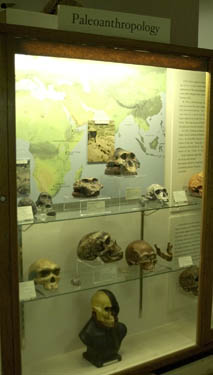
Currently, the museum boasts diverse exhibits including some devoted to bioarchaelogy, systems of writing, paleoanthropolgy (which focuses on history of human evolution), world music and the City of Petra, whose Kaznah (treasury) was featured as the resting place of the Holy Grail in “Indian Jones and the Last Crusade.”
“The museum’s future plans are to continue to raise awareness that we exist, to continue to raise awareness about the opportunities for students. It’s all about getting the word out,” Pitblado said. “Students love museums, they love the idea of working in museums, but they never know how to pursue it. I never knew. I just stumbled onto it by happenstance.”
Toward this purpose, the museum operates as an opportunity for USU students to learn the basics of museum work. From designing and creating exhibits to washing the glass cases that house them, students perform the day to day work the keeps the museum functioning, Pitblado said.
“My goal is to send forth young people, students, from here who are trained in the basics of museum management,” she said. “If you think about all the museums around the state of Utah, who do you picture? You picture little old people and they’re dying really fast. We can’t keep up. We need people who are trained in how to run these places so that our little museums can benefit.”
Though the program is still small, Pitblado said that anthropologists are needed more today than ever before.
“If you look at the world and where we are at, we have got to promote understanding of other cultures, whatever your politics, it makes no difference. It’s a positive goal to try to interact with and relate to other cultures, and that’s what anthropology does,” she said.
Even though she realizes the most typical response to the query: why study the past is ‘if we can understand past mistakes, we can learn from them, Pitblado maintains there is an even greater reasons archaeology, a branch of anthropology, is so popular.
“Understanding the past is so inherently cool,” she said. “There’s not going to be an Indiana Jones in the accountant world, going ‘look at me in my business suit,’ nobody’s going to go to that movie; [but] people are fascinated by where we came from, by who we used to be, by how we got to where we are, by the process that brought about this trajectory versus this one. It’s knowledge for knowledge’s sake.”
-mattgo@cc.usu.edu
(Photo by Jamie Crane)
(Photo by Jamie Crane)
(Photo by Jamie Crane)