
USU may lose federal agricultural funding
President George W. Bush has proposed a budget cut that would eliminate needed funds for agricultural research at Utah State University, said Paul Rasmussen, interim dean of the College of Agriculture and director of the Utah Agricultural Experiment Station.
“These funds have come every year since the beginning of the Experiment Station,” Rasmussen said.
Overall, the proposal would cut $100 million in 2006, and the remaining money – about $100 million more – would be slashed in 2007.
The budget proposal would cut formula funds for all land-grant schools, he said. This money from the government is used to confront immediate problems and for research projects.
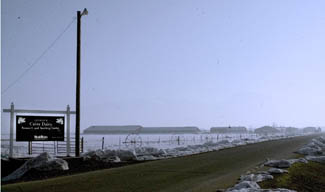
USU has received formula funds each year that support more than 200 research projects, 18 experimental farms, plant and animal breeding and multi-state research meetings. Rasmussen also said there are many emerging problems that come out each year that need immediate attention.
Animal health, farming, and forestry programs would all be impacted by this proposed budget cut, including research being done on the West Nile Virus and other critical diseases and situations that USU is working on, he said.
Rasmussen said USU receives about $2 million from the formula funds, and the state government matches those funds with at least another $2 million, which could easily be cut as well.
Research and experimental projects would not be the only thing affected by this cut. Rasmussen said the faculty and students involved in research would take a huge hit if funding was eliminated. There would be 140 teachers, 373 classes and 10,000 student credit hours impacted at USU if the formula funds were cut.
“Most likely we would lose excellent faculty positions because of the lack of money from the government,” Rasmussen said.
Rhonda Miller, a faculty member in agricultural systems and technology education, said everyone with experiment stations would be at risk of getting cut.
“All research dollars would be in jeopardy,” she said.
Right now, Miller is working with nutrients and the environmental impacts. She teaches numerous courses and has research projects on farm safety that would likely be affected if the budget cut gets approved.
According to the Associated Press, the Bush administration is turning the funding into competitive grants with hopes to attract high caliber scientists and to make critical national research issues the focus. There would still be money available to schools through theses grants; however, it would be such a sudden change that many people and institutions would be impacted.
The competitive grants would not work out well for USU, Miller said. Most of the smaller schools won’t have a chance in competing on the national level.
“Much of the research at USU is specific to the state, not to national issues,” Miler said.
Rasmussen said that if the formula funds were wiped out, at least 40 states would lose money from the federal government. The smaller states would feel the most devastating impacts. The western region alone receives about $127 million from the federal government in formula funds and if the proposal goes through Congress, it would be completely eliminated in two years.
“This is something that we will always have to worry about,” Rasmussen said. “We will have to make sure there is value to the formula funds and that everyone knows this is not in the best interest of the United States.”
-speery@cc.usu.edu
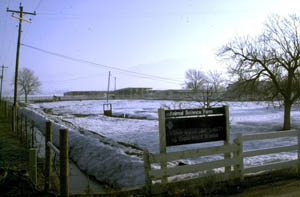
The Animal science farm is of the many research farms that is funded through federal and research grants awarded to Utah State University. Bush´s proposal would eliminate half of the funding by 2006 and all of the funds by 2007. This proposal could result in the elimination of jobs within the College of Agriculture. (Photo by Michael Sharp)
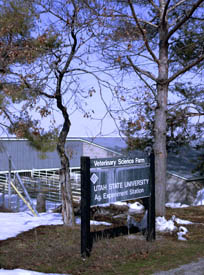
The Veterinary science farm, a USU agriculture experiment station, is one of the many research facilities that may be affected by Bush´s proposal. Paul Rasmussen, interim dean of the College of Agriculture, said this proposal would eliminate $2 million of federal funds. (Photo by Michael Sharp)