
Selecting sculptures for students’ enjoyment
Utah State University is home to many works of art. Pieces large and small are peppered around campus in museums, galleries and displays, or merely sitting out along the paths that students travel every day.
Victoria Berry, chief curator of the Norah Eccles Harrison Museam of Art, said most of the sculptures seen on campus were acquired in the 1990s during the tenure of USU President George Emert. Berry said Emert created the Campus Sculpture Committee, which oversaw the selection and purchases of individual pieces.
“He created a fund that helped finance a number of these acquisitions,” Berry said.
While the Campus Sculpture Committee may not be the force it once was, Berry said the collection continues to grow. With repeated years of budget cuts, most of that fund, including money for sculpture maintenance, has mostly evaporated but Berry said in some circumstances a piece will be gifted to the university by donors. USU also houses sculptures owned by the sate of Utah through state legislation that mandates 1 percent of construction costs be allotted for arts.
“The new Ag building will have a sculpture from the 1 percent for the Arts,” Berry said.
Sojourn by James Russell
Located just northeast of Old Main and steps away from the Block A lies Sojourn, a stainless steel piece made up of two curved arms reaching up and towards each other. Berry said that Sojourn is perhaps the oldest of the outdoor sculptures and is owned by the state of Utah.
According to documents provided by the Eccles art museum, the two arms of the sculpture represent tension and energy, reaching for each other and nearly touching. Sojourn’s shiny steel surface is highly reflective and it is described as absorbing and reflecting the world around it simultaneously. The word sojourn means “a temporary stay” and its placement in an academic setting relates to the time spent at USU by each student.
The museum documents say: “Every student completes a sojourn at USU, a time filled with a myriad of experiences and memories. What is absorbed and experienced during this time will be carried a lifetime and, in turn, what is learned is reflected by the student.”
Troika by Frank Riggs
In July 2010, the Caine College of the Arts was formed and moved into the building formally housing the University Press and Scholarly Publications. Berry said in order to distinguish the building, the museum decided to relocate one of the campus statues to that location. Originally Berry thought of moving Snafu, also known as the “french fry sculpture,” but the option presented difficulties.
“Snafu didn’t fit,” Berry said.
After some consideration, it was decided that Troika, a curved red statue formally situated on the plaza of the Chase Fine Arts building, would be moved to the new offices of the CCA.
“Troika just seemed like the best fit,” Berry said. “It looks wonderful out there and it’s an iconic image for the college.”
Nick Morrison, senior associate dean of the CCA, said the statue seems right at home in its new location.
“I think that it’s way cool to have art at an arts building,” he said.
Morrison said the concrete was poured for Troika in late September, as he remembered it, the day before Logan’s first snow of the fall. He said the statue has facilitated in giving directions to the otherwise inconspicuous building on the east end of 800 North.
Berry said there’s also a serendipitous aspect to Troika’s new home, which is seen from the road, as the shapes that make up the sculpture seem to spell out the initials of the new Caine school.
Tilting Arc by George Baker
USU’s kinetic sculpture, Tilting Arc, is located at the west entrance of the fine arts plaza. The sculpture’s multiple moving parts turn and sway in the breeze and according to museum documents the piece “immediately announces ‘you are approaching an arts complex’.”
Tilting Arc underwent corrective maintenance last year, as it was disassembled for a year and returned to full moving operation in March 2010.
“This is a very finely balanced piece of equipment,” Berry said.
Morrison said the piece is one of his favorites because of the way it involves both movement and sound as the different arms rotate.
“I’ve always liked that one,” Morrison said.
Four Without by Robert Winkler
Berry said that the four wooden pillars outside of the College of Natural Resources weren’t necessarily intended to act as a reference to nature and forestry, but the sculpture certainly seems to fit the mood of its location.
“We placed it in front of the Natural Resources,” she said. “It was made out of wood and we liked the way it had interplay with the architecture.”
Four Without’s arrival in Logan came as the result of a sculpture contest held at USU in 2000. Ten pieces were temporarily placed around campus with four being chosen as purchase awards for the university collection.
The piece consists of stacked planks of cedar wood, reinforced with steel. Each pillar is nine feet tall.
Pivotal Concorde by David L. Deming
Perhaps the largest sculpture on campus, Pivotal Concord spans 40 feet and sits east of the Merrill-Cazier library. According to museum documents, Deming wrote that an inspiration for the piece was the Concorde Jet, specifically the way it bridges continents.
Deming’s sculpture is a prominent feature on campus, not just for its size. Berry said the location for Concorde is particularly good.
“It ends up being a wonderful choice,” she said. “It picks up the line of the mountains.”
The Eccles museum is primarily responsible for the upkeep of sculptures on campus, and Berry said Pivotal Concorde has seen it’s share of wear and tear over the years as students commonly stand on its ramps. Maintenance is no simple task, and a cleaning and paint job, like the one Pivotal Concorde has received in the last year, costs thousands of dollars.
“It’s public art, this is going to happen,” she said.
Knowing that public art is a hands-on installation, Berry said the only thing she really hates to see are people using the sculptures slopes for skateboards and other wheeled devices, as damage to the surface can create rust that permanently damages the sculpture.
“Tennis shoes are much nicer,” she said.
Musician by Thakernpole Kampalanont and Prasong Wanmakehjorn
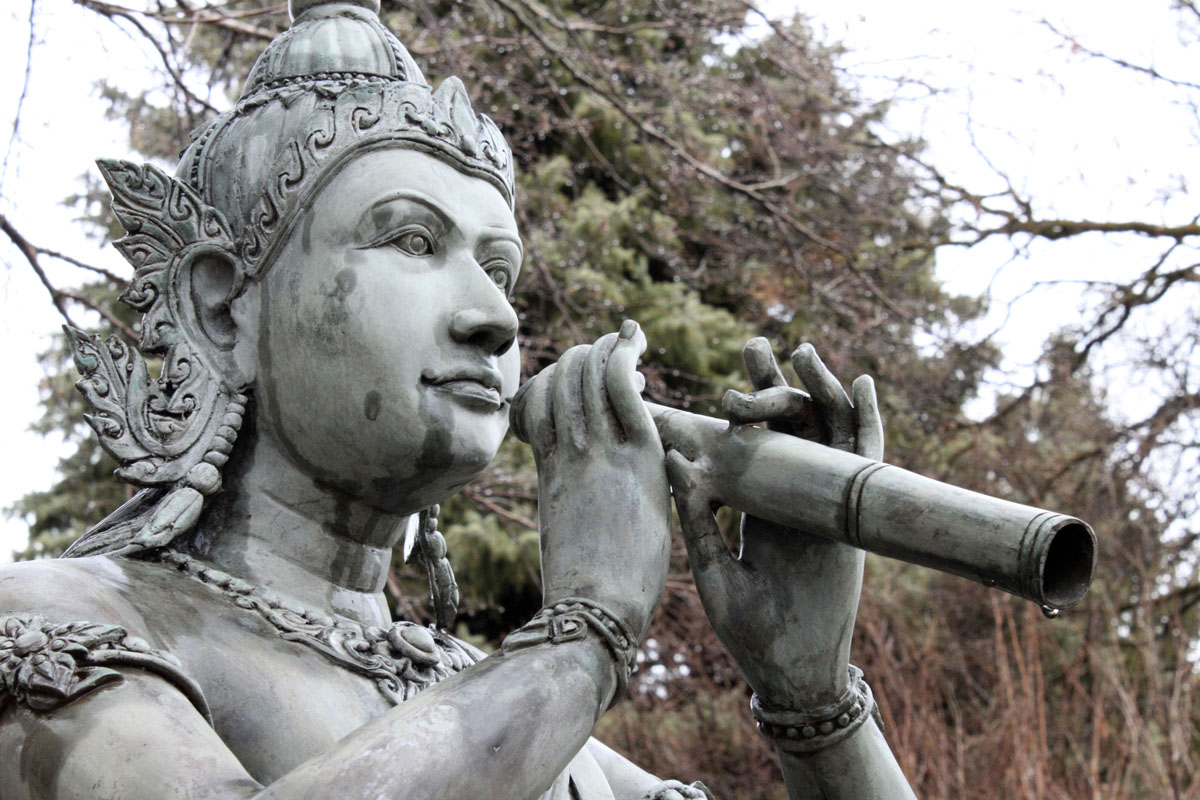
Between the Animal Science and Geology buildings sits a curious flautist made of bronze. The plaque tells passers-by that it is Phra Apaimanee, a prince in popular Thai culture, whose magic pipes soothe all who listen.
Musician was gifted to USU by alumnus and then-Permament Secratary of The Ministry of Agriculture and Cooperatives in Bangkok, Tweesackdi Sesaweech. Berry said the piece was designed to be displayed indoors and while the prince looks cheery as ever, the sculpture has seen significant damage.
“It’s decaying, it’s breaking down,” Berry said. “It will, someday, self-destruct.”
Berry assured that day was a long way off.
– b.c.wood@ag
giemail.usu.edu