
Powwow Pride
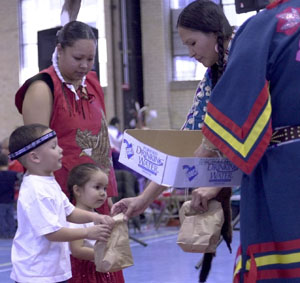
All the mats and hurdles at the Nelson Field House have been pushed aside to accommodate for a cake walk, a concession stand and a coloring contest.
A celebration as well as a competition, the 32nd annual Utah State University Echoing Traditional Ways Native American Pow-Wow is here.
“A powwow is a time to celebrate one’s life and give thanksgiving. It’s a time to socialize and bring people together,” Native American student programs coordinator, Sam Curley, said.
Friday March 4 and Saturday March 5 tribes met to compete in six traditional dance styles: Traditional men’s and women’s, Women’s Jingle, Men’s Grass, Men’s Fancy and Women’s Shawl. Dancers were judged by their style and points were earned by how well they keep time with the beat, whether they stop and start on time and also their costumes.
All ages competed. Even the very young mastered the complicated footwork. Moccasins lightly skimmed the floor while fans made out of feathers and decorated sticks, called coo sticks, gracefully sliced through the air. The crowds cheered as the dancers concentrated on their steps. At the end of each dance, competitors lined up so they could be judged.
“Today I’m doing Jingle, sometimes I get nervous before I perform, but I’ve come here for the past 18 years,” said Crystal Loya, a Navajo/Cauhilla and a freshmen majoring in history.
Traditional costumes were brightly colored with intricate beadwork. They were accessorized with feathers, sequins and fringe. Many hours are put into the construction and the outfits are often considered sacred and can be used for other ceremonial rituals.
“You can’t buy these things at a store, the beadwork takes forever. It took my grandma a year to make my sister’s dress,” said Challis Baldwin, a Lemhi Shoshone-Bannock from Idaho.
Drummers sat around drums the size of tractor tires, beating out songs for the competitors to dance with. The drums were stationed around the arena, each manned by a different tribe. Each group learned a set number of songs, one for each category. The groups took turns playing, going around the arena in a clockwise manner, chanting and pounding on their instruments in perfect unison.
“I learned to play with my family. We’ve done this all our lives,” Orville Morin, a Shoshone from Fort Hall, said. “It’s an adrenaline rush, a natural high. You beat off the power of everyone else.”
On the fringe of the dance competition booths were set up. Vendors displayed pottery, art, jewelry and beadwork. Concessions offered both traditional and nontraditional food for those desiring tacos, hotdogs, fry bread or nachos.
The two day festivities were organized by USU’s Multicultural Student Council and the Native American Student Council. They selected the head staff as well as the Head Man and Woman.
This year two USU students were selected. Sonny Bryant, a Navajo from Arizona, and Alicera Bulltail, a Crow from Montana, were selected primarily for their dancing ability, but also because of their leadership and the fact that they have been role models in the American Indian community.
“The Native American culture is alive and doing well. It is a continued tradition as well as a way of life.” Curley said.
-amcconkie@cc.usu.edu
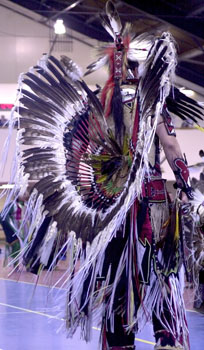
The older members of the American Indian Nations had their turn on the dance floor. Attendants at the powwow stood to honor the men as they danced. (Photo by Jamie Crane)
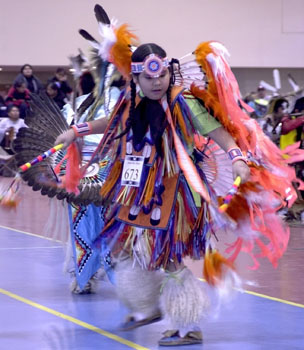
A youth dancer competes at the 32nd annual Echoing Traditional Ways Pow-Wow Saturday. The event was held in the Nelson Fieldhouse. (Photo by Jamie Crane)