
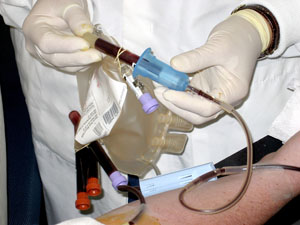
Giving plasma means money for some students
“I’d give plasma, but I’m afraid of big needles,” Brandon Dansie, a senior studying business, said.
But for many Utah State University students, despite the needles, donating plasma is an easy way to make money. Lane Blake, a junior studying economics and finance, said he generally donates plasma once a week to pay for gas.
Blake said each time he goes he does some paperwork and is asked some questions. He said he reviews his homework while his plasma is taken and then leaves. For each donation he is paid $20 or $25, he said.
Blake, who donates at Western Plasma Bank, said the transfusion itself isn’t painful to him and that he doesn’t feel tired afterward.
“Obviously its like any needle stuck into you,” Blake said. “It hurts when it’s going in, but once it’s there I really don’t notice it any more.”
The majority of the donors at Western Plasma are USU students, said Bryant Kitchen, assistant manager of Western Plasma and a USU junior studying nutritional science.
Kitchen, himself a plasma donor, said the blood is taken and the plasma is extracted from it by a process called plasmapheresis. The blood is drawn, portions at a time, and the plasma is separated from it through a process called centrifugation. The red blood cells are then put back into body by the same needle and line from which they were drawn. The entire system is closed, Kitchen said.
The process is repeated until an appropriate amount of plasma has been taken, which is determined by body weight, Kitchen said. Women typically give about 700 milliliters and men give about 810 milliliters, Kitchen said.
After each donation, the needles and tubing are replaced, Kitchen said.
Bruce O’Very, a pediatrician practicing in Logan, said as long as the plasmapheresis system is closed, there is no danger to students when donating plasma.
“The biggest issue is the maintenance of a closed system. If there is no break in the system, the risk is zero,” he said.
After each donation, the body compensates for the loss of plasma, O’Very said. The albumin and antibodies can be replaced in hours, he said. The fluid itself is transferred into the blood vessels from the third volume spaces, which are spaces between tissues, he said. Within 24 hours all the components of the plasma have been replaced and the third tissue spaces are replenished.
Because the body needs this time to replace lost fluids, it is probably best not to exercise for 24 hours after each plasma donation, he said.
“It might be a problem to donate twice a week with an existing exercise program,” O’Very said. “For me, that would be a mistake.”
Gretchen Wyatt, manager of public affairs for the Plasma Proteins Therapeutic Association, said she doesn’t think anyone should be concerned about safety when giving plasma.
Marketability of the plasma is driven by adherence to quality standards. Two of the highest standards are the International Quality Plasma Program (IQPP) and Quality Standards of Excellence, Assurance and Leadership (QSEAL), Wyatt said.
Western Plasma follows both IQPP and QSEAL standards, Kitchen said.
In addition, state and federal regulations ensure that not only is a high quality of plasma obtained, but that there is no danger to donors, Kitchen said.
Kitchen said donating plasma is great for students because they can study while they donate and can make $180 to $200 a month doing it.
Wyatt said that pay received for plasma donation is not a payment for the plasma itself – the plasma itself is truly a donation.
“You don’t sell plasma,” she said, “donation centers compensate for time.”
Plasma donations help hemophiliacs and cancer patients, Kitchen said. He said the fibrinogens in the plasma are clotting factors that can help hemophiliacs. The globulins supply white blood cells that can help cancer patients undergoing chemotherapy, he said.
“Plasma donations are not used for cosmetics,” Kitchen said. Plasma donations are used for strictly medical purposes, he said.
-jks@cc.usu.edu