
‘Kaora’ it is life
When the original Polynesian explorers set out in small wooden canoes they had no idea the vast and varied cultures that would spring out of their efforts.
They probably had even less idea that thousands of years later hundreds of people would gather at Utah State University on a cold winter night to celebrate those cultures.
Whether those first explorers knew it or not, Saturday was this year’s annual Polynesian Student Union’s luau. The yearly event draws crowds from all more than Utah to celebrate the many different lands of the Pacific.
The event’s master of ceremonies, Kilifi Matavao, told the crowd of over 800 people, “I hope you’ve felt something different tonight. We call it mana, the spirit of our people. It’s what inspires us to be a happy, to sing, to dance, to get together. It’s very special to us and we’re happy to share our mana with you.”
Hawaiian shirts and plastics leis were everywhere as people began lining up for dinner. By the 5:30 p.m. start time, when guests were allowed to begin eating, the line already stretched from in front of the Taggart Student Center’s Ballroom to the east side doors.
The International Lounge was filled to capacity with 20 long tables for attendees to enjoy their meal. The evening’s food consisted of chop suey, kalua pork and teriyaki chicken along with guava cake for desert.
“The food rocks,” Meghan Passey, a sophomore studying math education, said. “I’m a fan of the whole Polynesian culture. I can’t get enough.”
After eating, the crowd, along with many newcomers, were ushered into the Ballroom for a performance of many different dances from around Polynesia by members of the PSU.
It was not a dance review; the audience didn’t just sit and watch. People in the crowd were invited to sing along and shout out encouragement to their favorite dancers, almost like fans at a basketball game.
Also, throughout the show, friends and family of the dancers would hop on stage and place money either one the dancer’s bodies or in their costumes as a traditional sign of good fortune. The PSU was prepared and offered change in ones for people before the show. The money will be used by the club for future events.
Polynesia is a region in the South Pacific that includes many island nations, each with its own unique culture. Six different nations were represented Saturday including Hawaii, Fiji, Samoa, New Zealand, Tahiti and Tonga.
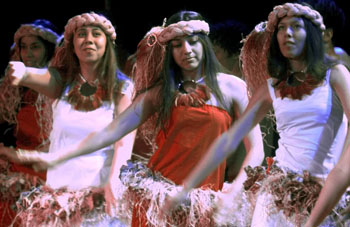
Hawaii started the show with several traditional hulas. The first one, Kahiko, was accompanied by one of the instructors singing in Hawaiian.
The hula is a way for the dancers to tell stories with their hands, Matavao explained.
“[It’s] the language of the heart and the heart of the Hawaiian people,” he said.
He later explained to the audience what some of the hand motions meant and taught them a simple hula called “Little Pearly Shells.” He then played it on his ukulele while the whole ballroom joined in.
After Hawaii it was Fiji’s turn to perform. They presented a traditional spear dance in which performers were armed with sticks and fan shaped clubs, which they would beat together rhythmically while chanting.
Along with spear dance was the Isa Lei Lia, where the female performers danced to the clapping of their male counterparts.
Kaipo Rokobuludrau, who traveled up from Lehi, Utah every weekend to teach the Isa Lei Lia, was pleased with her students.
“It came out very well, or as we say in Hawaii, ‘Mai ka’i’,” she said.
Next to perform was Samoa. Located in the center of Polynesia, Samoa is often called the heart of Polynesia. The dancers knelt down to perform various chants and motions including a little local flavor when they did the traditional chant of “Go Aggies, go Aggies, hey, hey, hey.”
They then sprang to their feet for several other dances ranging from some more modern style couples dancing to a traditional slap dance or “mosquito dance” as Matavao jokingly referred to it.
The next destination for the audience was the Land of the Great White Cloud, more commonly referred to as New Zealand.
Dancers performed traditional of New Zealand’s indigenous people, the Maori, including the Kamate Haka, a war dance made world famous buy New Zealand’s national rugby team the All Blacks.
Along with dancing performer swung poi balls, small pouches of pounded taro root at the end of long strings and Ellis Patane, one of the dance instructors, demonstrating his skill with the Taiaha, an ancient traditional Maori weapon carved entirely of wood, with a spear like point at one end and a long shaft with a sharp, flat blade along it’s edge.
“It’s crafted by a relative who has passed on. His name is on in, his face is on it so basically you use an ancestor as a weapon and he guides you on your walk as a warrior,” Patane said.
Following New Zealand was Tahiti. The Tahitian have a way of telling stories very different from the Hawaiians’. Rather than their hands they use their hips.
“If you watch the hands while Tahitians dance, you miss the whole show,” Matthew Leituala, the Multicultural Student Services’ new Leadership and Activities Coordinator, said.
The final country to present was the Kingdom of Tonga. As soon a Matavao mentioned the name Tonga the audience’s screaming and cheering rose to an even higher level.
For the Tongan section, performers provided their own percussion, banging out the rhythm on steel chairs, the stage floor and tribal drums three feet deep.
While many of the on-stage performers were from or had ancestors from the countries represented, some were not.
“I’ve always loved the culture and I’ve always felt welcome in the club even though I’m not Polynesian,” dancer Eileen Lamb, a senior in special education, said.
“Polynesian culture is in my heart,” Nora Quintilla, a senior in parks and recreation and another dancer, said.
The night was a family event with families of different sizes and age groups attending. The Crane family traveled from all over to be together, with their grandparents traveling a total of 3000 miles, said Chad Crane, a junior majoring in art.
“Family is the most important thing in Polynesian culture,” Leituala said. “Dance is an expression … life based around family.”
-steveshinney@cc.usu.edu
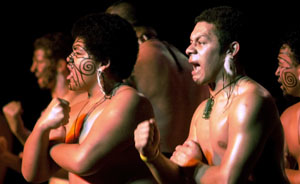
With painted faces, dancers representing New Zealand perform the Haka, an ancient Maori warrior dance, for the audience at the Pacific Rhythms Luau Saturday evening. (Photo by Michael Sharp)
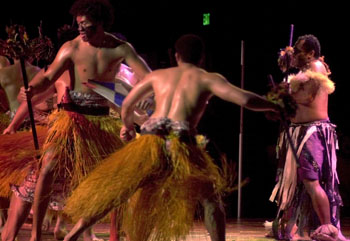
Dancers representing Fiji perform a Spear Dance during the Pacific Rhythms Luau Saturday, hosted by the Polynesian Student Union. (Photo by Michael Sharp)