
Weather takes a turn in time for Baby Animal Days
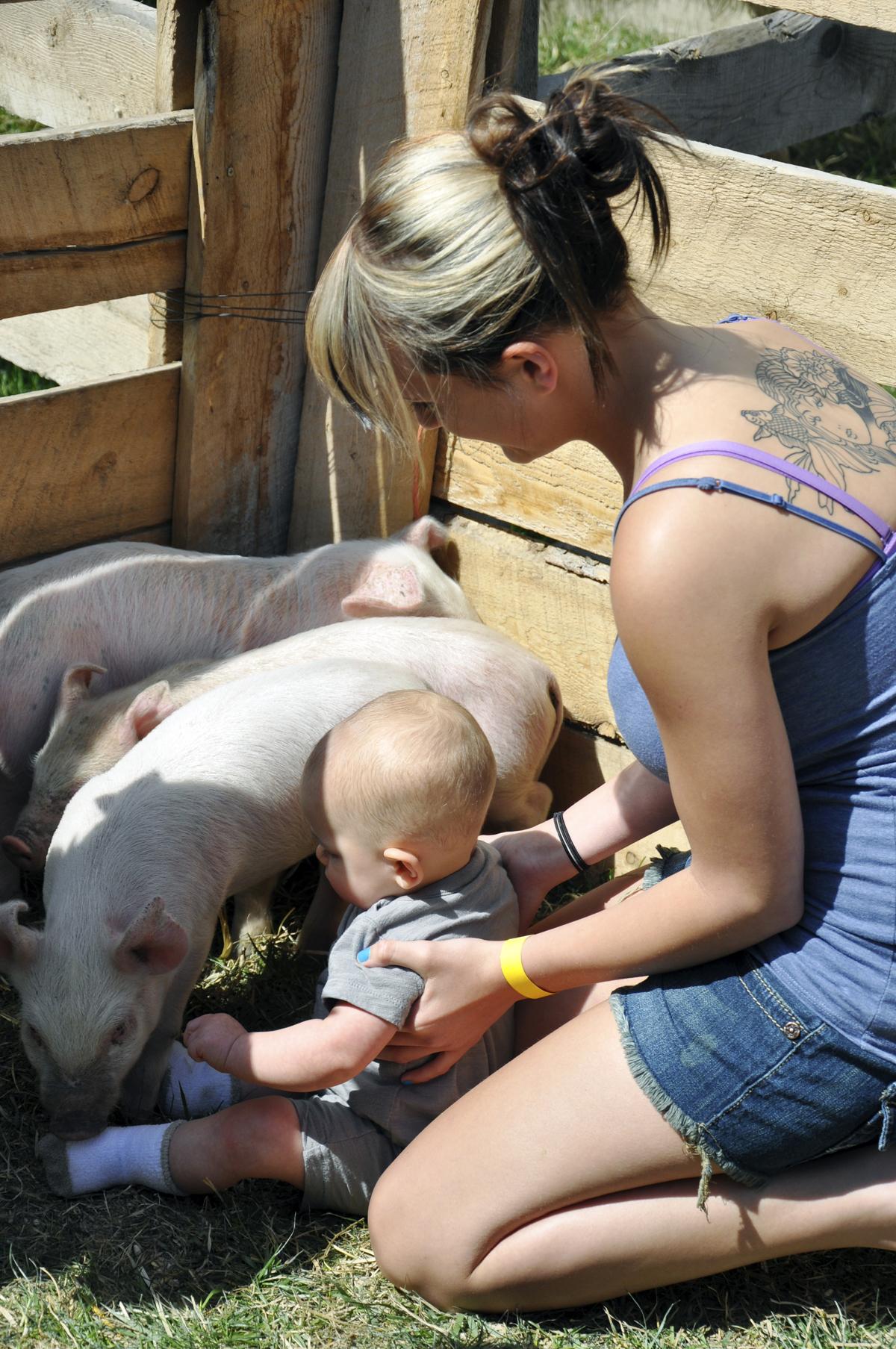
Strollers lined the fences of animal pens as families waited in queue to board a miniature train. Several women were seen cooing at and talking to the piglets – the phrase “so cute” was said often.
One father bleated at a sheep while holding his child on his shoulders at. Little girls shrieked as boys pointed in awe at the abundance of animal droppings. Tiny goats huddled together in the corner of their wooden pen and flinched every time a curious child bumped the gate.
These were all common sights and sounds at the American West Heritage Center during Baby Animal Days on Saturday.
The sky was sunny – a contrast to the snow Friday.
The event featured many farm animals historically common in American farms, but the three-month-old brown bears in the Bear World exhibit were the favorite for several visitors.
Kimberli Robison, a resident of Richmond and attendee at Baby Animal Days, said the event was better this year than last.
“We didn’t have to wait in line for two hours,” she said of the wait to see the cubs. “I look forward to the bears.”
Two of Robison’s children, Natali and Leasa, also liked the bearcubs.
“They were cute and cuddly,” said 8-year-old Natali. “They look hyper, running around.”
“They were so cute,” said 5-year-old Leasa. “I like the brown one.”
The bears weren’t the only small, fuzzy attraction.
The park also featured a two-week-old holstein calf that appeared it had just recently learned to walk. There were also tiny swimming turtles, several piglets, dozens of goats and rabbits, and scores of chicks and ducklings.
One of the red-eared slider turtles on display was 1-year-old and about the size of an adult human hand. All the rest of the turtles were one-week-old and not much bigger than a silver dollar.
“My kids like the turtles,” Kimberli Robison said. “We have turtles at home, but they’re not as cute as these ones.”
Baby Animal Days also featured a carousel with ponies tied to it, which allowed children to ride them – the favorite of 7-year-old Cassidy Greenwood.
“We got to ride (the ponies),” she said, adding that she also enjoyed petting them. Cassidy’s 10-year-old sister Charly said she liked the pony ride, but it wasn’t her favorite thing to do.
When asked what she liked best about Baby Animal Days, Charly said, “Usually the whole farm, because it’s got lots of things for people to do.”
Elsewhere in the park, 6-year-old Jonah Negus said he liked all the baby animals, but he liked the “plain old baby cows,” mostly because he got to pet them, he said.
Jonah’s father, Ben Negus, a resident of Garden City, said his children enjoyed the event.
“It’s been pretty good,” he said. “It’s mainly for the kids. We just barely found out there are bears here.”
Bill Varga, executive director of the American West Heritage Center, said some attendees might not have seen the bears this year.
“People come here because of the bears,” Varga said. “The whole thing wouldn’t have run if we didn’t have collaborators.”
One collaborator is the USU Charter Credit Union, which helped foot the bill to bring the bears to Logan.
“It’s definitely the most popular exhibit here,” said James Boyd, USU Charter Credit Union vice president of Marketing. “With this exhibit we’ve been able to help double the attendance at Baby Animal Days. It’s bringing in a lot of people.”
Jody Robison, a seasoned Bear World volunteer and volunteer at Baby Animal Days, said the cubs are used to being around humans.
“Our bears don’t develop aggressive attitudes toward people because they’re around us all the time,” Jody Robison said. “Twenty-four hours a day we’re with them for the first four months. We have physical contact with them for the first year. They think of us as family.”
The six bears at Baby Animal Days were each three months old. Jody Robison said there is a short time window in which the cubs can be shown in exhibits like Baby Animal Days.
Jody Robison said when the bears are 1 year old, they are taken to the yearling area in the park, adjacent to the adult population, where the bears can see and get used to each other.
“When they’re 3, we put them in the adult population,” Jody Robison said.
Stacy Egley, a member of the park’s pioneer staff, said she helped raise some of the animals on display.
“They’re all from here on the farm,” Egley said. “We breed them and raise them with our staff year-round.”
Egley said though Baby Animal Days is geared toward children, parents also enjoy the park.
“We love to show the baby animals to the kids,” she said. “Me as a parent, I love to see my kids look at the baby animals and see their reaction.”
– tavin.stucki@aggiemail.usu.edu