
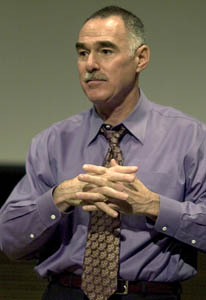
Nicotine truth exposed: Former Phillip Morris employee speaks to USU students
On April 14, 1994, seven people representing seven different tobacco companies said under oath nicotine wasn’t addictive. Just 14 days later, Victor DeNoble entered the same court with evidence showing otherwise and claimed the tobacco companies knew it.
In 1994, DeNoble became the first “whistleblower” against the tobacco industry and he shared his experience with Utah State University students Wednesday as part of the Arts and Lectures series on campus.
DeNoble said he used to be employed by Phillip Morris. The director of Philip Morris came to DeNoble, he said, and told him nicotine kills 138,000 people every year from heart attacks and brain strokes.
“By 1980, Philip Morris had figured out a way to make cigarettes without nicotine,” DeNoble said. “The problem is if you take the nicotine out of cigarettes, people don’t smoke.”
Philip Morris wanted DeNoble to develop a man-made drug that would be less damaging to the heart, but still be addictive, he said.
“My job was to create a safer cigarette,” DeNoble said.
So DeNoble started his research in a lab at Phillip Morris. He said all his lab windows were painted black and all the doors had special locks. He said he started experimenting with rats and drugs that had already been proven to be addictive.
With the heroin experiment, he said, the rats were addicted within three weeks.
DeNoble said he set up a similar test with nicotine, and within a few weeks the rats were up to the equivalent of 90 cigarettes per day.
“The tobacco industry said people smoke because actors and actresses smoke in movies, because people smoke in advertisements. People smoke because they want to lose weight,” DeNoble said. “My rats have never been to the movies. Rats don’t read magazines. I’ve never found a rat trying to lose weight, and I can guarantee you this – I’ve never seen a rat trying to act sexy for the rat next door.”
DeNoble said he told Philip Morris what he had discovered and they discredited him, saying he couldn’t prove that nicotine affects the brain because it was distributed through all the other organs first.
He said he then started injecting the drug directly into the brain, and after six months the rat was addicted due to a change in a certain part of the brain that controls addiction.
DeNoble went to Philip Morris again with his results and he said they took his rats so he couldn’t perform any more brain experiments and would work on the drug they wanted.
DeNoble said he still continued his experiments on the brain. He worked on a monkey brain next, demonstrating that nicotine had changed the brain, even when the subject died without nicotine in their system. He said he then went in search of a human brain to study.
“We’ve proven nicotine can change the way a rat brain works. We’ve proven it can change the way a money brain works. There is only one thing left,” DeNoble said. “We’ve got to get us a person’s brain and it’s got to be fresh one, too.”
DeNoble said he found the brain of a 63-year-old man who was dying of lung cancer from smoking, and with his brain it proved that nicotine had the same effect on humans.
He said he then took his results to Philip Morris again, and they fired him.
“What makes you think we are going to let you work here after what you did?” DeNoble said the company asked him. He replied, “You’re going to let me work here because I found a safe drug.”
In 1981, DeNoble found a drug that was just as addictive as nicotine, but not as damaging to the heart.
DeNoble said Phillip Morris was originally pleased with the results, but in 1985 they came back to him and said they couldn’t sell the drug because it would prove they were lying and would cause them to lose money.
DeNoble said he was really fired this time, but before he left he was able to take some top secret documents from the lab, even though he legally could not contact anyone about them without having his words thrown out of court.
DeNoble said he has been followed by several private investigators hired by Philip Morris ever since he left the company.
A lawyer he had hired, DeNoble said, returned some of the evidence to the tobacco company. But with a small amount of evidence his wife saved, he was eventually able to contact the FBI by mailing a photograph that had his fingerprints all over it.
“I mailed it on Monday. The FBI came to the house on Thursday.”
DeNoble’s next step was telling his story to a federal judge. President Clinton called DeNoble at his home and had him taken into protective custody.
On April 28, 1994, Victor DeNoble testified under oath in a federal court what he had discovered while researching at Philip Morris, 14 days after seven tobacco companies testified that nicotine was not a drug, nor was it addictive.
Since then, tobacco companies have been charged $785 billion for lying to the government, tobacco advertising is more restricted and many states and counties have become smoke-free, DeNoble said.
DeNoble said his motivation for going to work with the tobacco industry was simple.
“They said, ‘we are killing people. Can you help?’ Who wouldn’t take that job? What a way to contribute,” DeNoble said.
The issue isn’t over, DeNoble said, although he no longer fears for his life. He said two FBI agents follow him and the tobacco companies need him alive, because if he were to die an actor would simply just read his words in court.
“You can’t cross-examine an actor,” he said.
DeNoble explained how nicotine addicts and said he wants everyone to understand how dangerous nicotine can be.
“I’ve never met a drug addict that didn’t say, ‘I thought I could control this,” DeNoble said. “And once you are a drug addict, you are a drug addict for life.”
-mikayliek@cc.usu.edu