
USU professor awarded national recognition
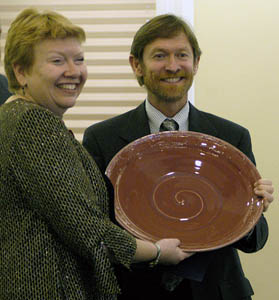
The “A” atop of the Old Main Building was litup blue for something other than sports Friday night. It was lit to honor Utah State University professor Bonnie Glass-Coffin.
“Now I rank with the athletes. I’m so proud,” Glass-Coffin joked at a reception in her honor Friday afternoon.
Glass-Coffin was recently named the Utah Carnegie Professor of the Year, a national award that recognizes professors for their teaching. Glass-Coffin’s love for students and her style of teaching that “pushes them to the edge of their comfort zone” have played a vital role in her achievements.
“I love the students. I love everything about them,” Glass-Coffin said. “It’s because of the students that we are here in the first place.”
The Professors of the Year Program is the only national awards program that recognizes college professors for undergraduate studies, Glass-Coffin said. There were more than 400 nominations for this award in 2004 and one professor was selected for the award from 46 states, Glass-Coffin said. She said Chris Fawson, the vice provost for Academic and International Affairs, nominated her for the award.
“It’s really humbling. There are a lot of really good teachers who haven’t been recognized by this award,” Glass-Coffin said. “I feel singled out in a way that is probably just lucky.”
In the summer of 2002, Glass-Coffin developed an ethnographic field school in Huanchaco, Peru. She said some students raised their own money to be able to go to Peru and participate. The students engage in a “cultural immersion” by living with the people of Peru, she said. They participate in interviewing and focus groups and learn to be “an insider” in the village, Glass-Coffin said.
“I try to get students out in the field doing research as much as possible,” Glass-Coffin said, “to get students to see first-hand the applications of academic concepts to real world issues.”
Glass-Coffin was honored for her achievement at a reception at the Haight Alumni Center where USU President Kermit L. Hall and Gary Kiger, dean of the College of Humanities, Arts and Social Sciences, spoke.
Hall gave a brief history of Andrew Carnegie and his philanthropic work. He said seven of the last nine Carnegie Professor of the Year awards have gone to USU professors.
“I say let the Utes have their football,” Hall said.
Hall also congratulated Glass-Coffin and said the “A” atop of the Old Main Building would be blue in honor of her Friday night.
“Congratulations, hearty thanks. A well deserved kudos to you,” Hall said to Glass-Coffin. “The best thing I can say to anyone at Utah State is ‘You’ve made a real difference’.”
Kiger highlighted three things that stood out to him about Glass-Coffin. He said she always worked on personal and departmental development, she had a deep interest in Latino families in the community and her work in the ethnographic field school in Peru has changed the lives of many students.
“The students will uniformly come back and tell experiences about this being a life-transforming experience,” Kiger said. “It stays with them forever.”
Glass-Coffin said she will be taking a break this summer to add new components to the field study. She said she wants to have students stay in homes of Peruvians rather than in hostiles with the rest of the group. She said she also wants to make the research a little more focused. She said she hopes these projects will help the community in which Glass-Coffin and her students stay.
“I want this project to be empowering for community change,” Glass-Coffin said.
Glass-Coffin has also been involved in local community efforts. Since Fall 2000, Glass-Coffin said she has worked with Hispanic and Latino families in Cache Valley in an effort to build better ties between Hispanic parents and their children’s teachers.
A student of Glass-Coffin, Beth McEvoy, said her professor makes the students open their minds to new ideas.
“She really helps us to think outside of the box,” McEvoy said. “She definitely deserves the recognition.”
“One rule of mine is to move my students to the edge of their comfort zone,” Glass-Coffin said. “The students here are so open, so inquisitive, so willing to listen to ideas that they haven’t heard before.”
Glass-Coffin said she believes teaching is one of the noblest professions in the world. She said as time goes by, there is less evidence that our government sees the important role that teachers have. She said teacher’s salaries reflect this and that teachers need more praise.
“Teachers create tomorrow’s citizens,” Glass-Coffin said. “We need to continue to pat teachers on the back, and not just the few that win awards.”
Glass-Coffin said the university supports her field study “in theory” but does not have the funds to support it financially. She said she believes the international education experience is important for students and hopes that, because of the success of program, there will be funding for it in the future.
“I’d love to see a scholarship for international travel for students,” Glass-Coffin said. “It would be my dream to have donors come forward.”
-meganroe@cc.usu.edu
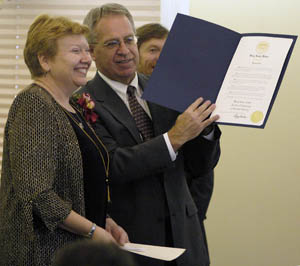
Provost Stan Albrecht presents Bonnie Glass-Coffin with a citation from Gov. Olene Walker congratulating Glass-Coffin on being named the 2004 Carnegie Utah Professor of the Year. Glass-Coffin is the seventh USU professor to receive this award. (Photo by Ryan Talbot)