
Never stop pushing
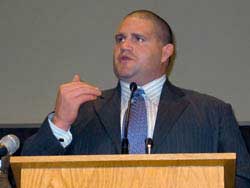
Rulon Gardner spoke to students, faculty and the community sharing the story of his journey from farm boy to gold-medalist.
Gardner spoke in the Taggart Student Center Wednesday about the obstacles he has had to overcome as well as his life-changing snowmobile accident.
“I get the opportunity to speak to about 50 schools each year. I feel a close connection to this valley. The mountains, the climate, the morals – it is just so familiar to my own home. I want people to understand what I went through so maybe they can benefit from it,” Gardner said.
Raised on a dairy farm in Afton, Wyo., Gardner grew up as the youngest of nine children. As such, he said he was often left with the benefit of being the youngest on a ranch.
“The crap all runs downhill and I certainly got my share of it as the youngest. All the jobs my older brothers and sisters didn’t want to do fell on me,” he said.
After graduating high school, Gardner said he went to the University of Nebraska and although he wrestled during that time, he never gave up on school. He said he eventually graduated from the education program, which helped fulfill his dream of becoming a teacher.
His presentation to the audience was centered on seven of the most important ways to overcome obstacles. The first was “back to basics.”
In regards to this, he said, “When we were young, we believed in ourselves. We knew we could do anything if we wanted to. What happened to that when we got older. Why did we lose our confidence?”
He encouraged students to stay close to what really matters in life. He said, when it all came down to it, taking care of himself as a person was more important than letting the world take over.
His second point was always turning a negative situation into a positive one.
Rulon related his school experiences of being a child with a learning disability.
“When the school counselor told me I couldn’t make it through college, my mom and I went to him and told him to give me a chance. I eventually graduated from Nebraska in their education program, the fourth hardest at the school,” he said.
Gardner’s other tips included enlisting the help of others and training hard every day.
“I went out there to practice every day and at the end I would ask myself if I had given it 100 percent. If I hadn’t, I did more laps and exercises to make up for it,” he said of his training to gain a place on the Olympic team. “I needed all the training I could get because I didn’t want to live knowing that I could have done better,” His next point was a reminder to “take care of business every day,” which he related to the gold-medal winning defeat of his Olympic opponent.
“The chance of me beating Aleksander Karelin: none, but the opportunity was there,” he said. “I knew that I had to try and that was the best I could do.”
It was at this time that he told of his snowmobile accident.
“That same drive that helped me to win a gold medal was also what almost killed me. After getting lost, I kept going and tried to find a way out and just got myself into trouble,” he said.
Gardner said after 18 hours in freezing conditions and being soaked from falling into a creek, rescuers arrived and took care of him. He said his strength and determination to endure kept him alive even at the point of death.
He tied both of his final points, “aim high when feeling low” and “don’t rest on your laurels,” in with his determination not to give up after the snowmobiling accident.
He said he had the option of giving up after the incident, but instead worked until he once again found a place on the Olympic team and won a bronze in the 2004 Athens games.
Craig Dart, guest lecturer at Utah State and distant relative of Gardner, enjoyed the presentation.
“I was amazed at his resiliency. Everything in his life told him he couldn’t make it. From his school teachers and peers to his family, everything seemed against him. Dart said he took all of this doubt and discouragement and turned it into something positive.” -nebutler@cc.usu.edu