
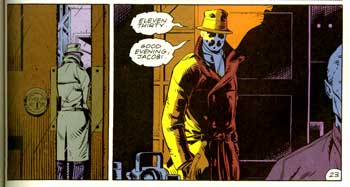
Nearly two decades after its publication ‘Watchmen’ continues to inspire television, movies and music through its unabashed vision of the superhero’s tortured soul
With films like “The Incredibles” and “Fantastic Four” garnishing overwhelming box-office success in theaters, it’s not difficult to see why the contemporary entertainment industry is ostensibly obsessed with superhero mythology.
Even more abundant is the current trend among Hollywood productions to deconstruct the superhero mythos and ask the question: “What would compel someone to put on a ridiculous costume and wage war on the criminal fraternity?” Several recent blockbuster films grapple with the psychological underpinnings behind popular culture’s ostentatious answer to the demigod and offer drastically conflicting answers. While “Spider-Man 2” chalks it up to adolescent escapism and personal responsibility, “Batman Begins” suggests that a significant lack of sanity is behind the creation of a costumed identity.
These critically acclaimed blockbusters have instilled traditionally campy genre films with symbolic depth and have grounded the mythology surrounding each larger-than-life pop icon with compelling humanity. But even with this progressive incentive to implement realism into worlds originally derived from multi-paneled “funny books,” the film industry has still failed to peer down the proverbial rabbit hole of artistic curiosity and complement that question with another: “what would really happen to a world comprised of superheroes?”
As Alan Moore suggests in his groundbreaking graphic novel, “Watchmen,” applying the word “apocalyptic” would be understating such a situation.
“Watchmen” establishes an alternative history of the world in which costumed vigilantes emerged in the 1940s and, following the introduction of their comic book counterparts, greatly influenced the events of the last century. In the troubled world of “Watchmen,” the United States has managed to achieve a clear victory in the Vietnam War while Nixon enjoys his fourth term as the president. Cold War-inspired tensions between the U.S. and Russia continue to rise and the only thing preventing nuclear war is the existence of Doctor Manhattan, a scientist involved with a lab accident that granted him omnipotence but rendered him incapable of comprehending human emotion. Due to emerging police strikes and increased public scrutiny, “superheroes” were eventually outlawed following the introduction of the Keene Act in the 1970s. “Watchmen’s” central plot follows the investigation of a conspiracy against “masked men” following the murderer Edward Blake, the civilian identity of the callous anti-hero “the Comedian.” The gritty chronicle introduces readers to a group of disturbed heroes with faults greater than their larger-than-life personas. Rorscharch, a brutal extremist that covers his face with an ink-blot covered mask, applies moral absolutism without compromise.
The second Silk Spectre harbors resentment for a life she was forced into by her hedonistic mother (the original Silk Spectre) and provides the vessel for Moore’s commentary about the glamorization of sexuality personified by scantily-clad heroines. The dysfunctional troupe is rounded out by Ozymandius, a utilitarian genius that used his abnormal status to establish a vast, multi-conglomerate empire, and the second Nite Owl, a solitary ornithologist with a passive obsession with his crime-fighting heydays. While, “Watchmen” addresses a myriad of questions surrounding morality, the central concept of the story revolves around the question of authority and who ultimately has the right to posses it. The title, “Watchmen,” refers to a Latin statement from Juvenal’s “Against Women” that is translated as, “Who watches the watchmen?”
A gripping, expressively complex yarn originally woven across a 12-issue mini-series that was released during the mid-1980s, “Watchmen” not only revolutionized the comic book industry, it redefined the entire realm of visual storytelling. With its unparalleled sophistication, layers of philosophical depth, and profound narration, “Watchmen” earned prestige among the greatest literary works of the 20th century. Inspiring everything from Richard Kelly’s cryptic cult favorite, “Donnie Darko” to the hit television series “Lost,” “Watchmen’s” vast creative influence has also had a ripple effect among the most inventive minds in Hollywood. In addition to Frank Miller’s edgy “The Dark Knight Returns,” Alan Moore’s riveting examination of the human condition through the exploits of costumed adventurers brought considerable legitimacy to a medium often belittled for its juvenile appeal.
Mack Perry is a critic for the Statesman. Comments can be sent to him at
mackp@cc.usu.edu.
(Book)
(Book)