
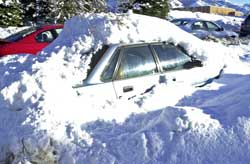
Tips for prepping your car for winter
It’s that time again. Getting out of bed and to your first class on time is getting increasingly harder. It’s official: winter is well on its way to Logan. But with all the snowy fun comes certain precautions. One such precaution is winterizing your vehicle.
Some students already realize the importance of this. “I always check my antifreeze level, make sure I have plenty of tread on my tires and put an ice scraper and a snowboard in my backseat,” Jordan Davis, a sophomore in business, said.
Others are somewhat oblivious to the situation. “I don’t think I’ve ever winterized my vehicle before,” Melissa Hansen, a undeclared freshman said, laughing.
Especially in an area that receives a reasonable amount of snow, winterizing your vehicle now can save a lot of money and inconvenience later.
Daniel King, specialist at Midas, explained some basic precautions people should take. Car fluids need to be checked and windshield-wiper fluid should be set to a 3:1 ratio of water to alcohol level, he said. Alcohol is used to prevent the fluid from freezing.
“Generally, the ratio is a little bit less during the summer, so you need to check for that,” King said.
The radiator fluid also needs checked, he said. The antifreeze-to-water ratio needs to be such that it won’t freeze in temperatures as low as 32 degrees below zero. “Once a radiator freezes, it’s not going to thaw until the weather warms up,” King said. “Not checking antifreeze potency is the most common problem with vehicles in the winter that Midas runs across.”
Tires are another thing to watch. Front-wheel drive and all-season tires are generally fine, so long as they have reasonable tread, King said. But if your vehicle uses snow tires, it’s a good idea to switch them out. “It’s not a bad idea to carry cables or chains if you plan on driving a lot in mountainous areas,” King said. “There’s nothing worse than trying to propel your vehicle forward with no traction.”
Cables and chains run around $35 at most auto part stores and are less expensive than having to be towed.
-miriahkdobbs@cc.usu.edu