
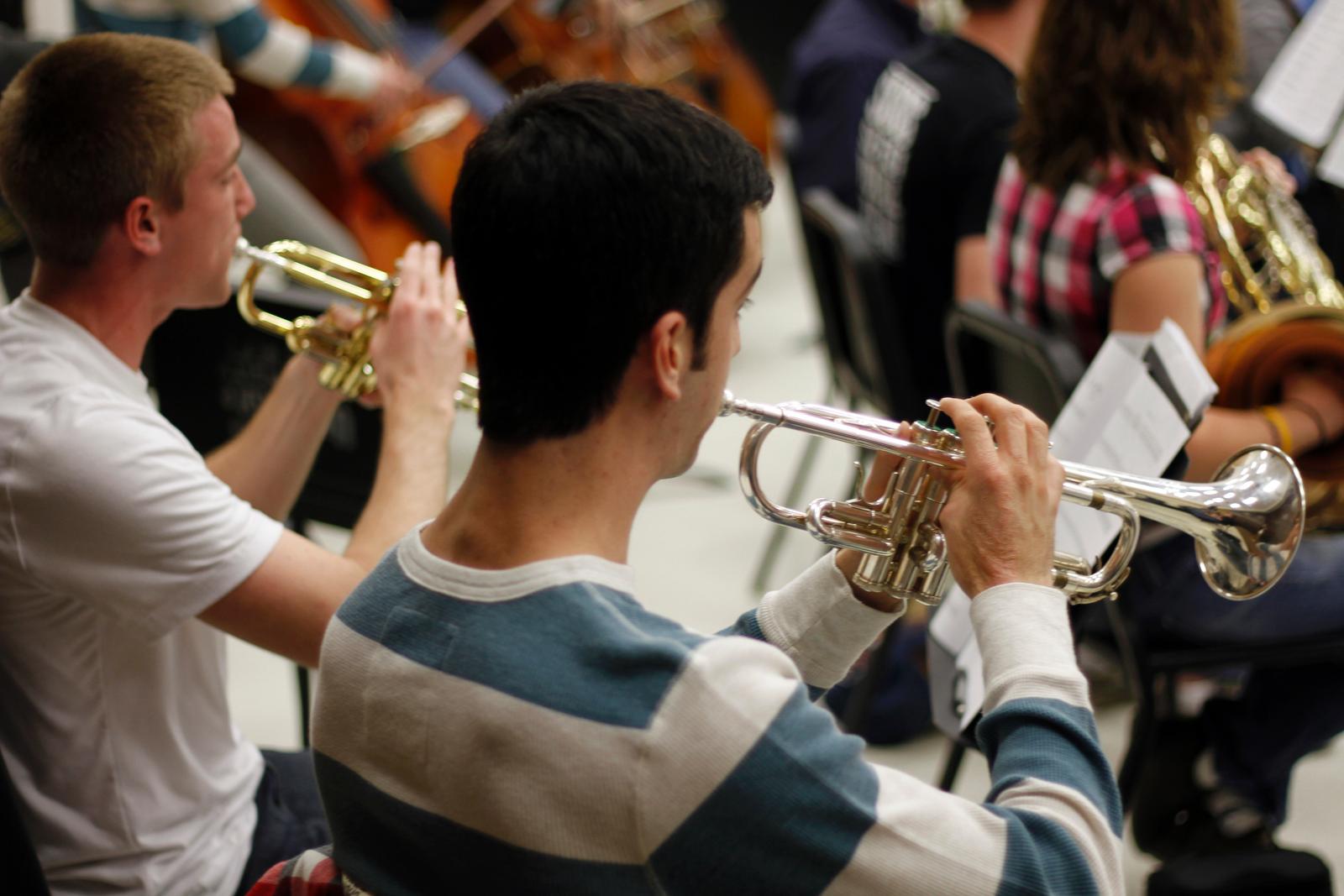
A competitive concerto
Every year the the music department in the Caine College of the Arts hosts a competition where registered music students are invited to perform a solo piece, traditionally called a concerto. The winners of this competition are then invited to perform with the USU Symphony Orchestra, under the direction of Sergio Bernal, associate professor and director of the orchestra. This year four soloists have been chosen to appear in the “Concerto Evening” concert on Thursday, March 28.
“You never know from year to year how the program will fit together because it is built around who wins,” Bernal said.
The winners are chosen from a pool of 20 finalists in a preliminary selection process. When a student submits an application to audition, it must be approved by their studio instructor who must make certain the student can play the music of the piece accurately and fluently.
The winners of this year’s competition are Nathan Southwick playing a violin concerto by Mozart, Marianna Cordan playing a french horn concerto by Strauss, Sara Mason playing a piano concerto by MacDowell and Clifford Tam playing a clarinet piece by Debussy. In addition to the four pieces, Bernal said he has chosen two other pieces which will complement the concertos well.
“The program works out in that the first three pieces come from a Germanic background,” Bernal said. “We have the Strauss french horn concerto and the Mozart violin concerto, so then I decided to open with Beethoven’s overture to ‘Egmont.’ I think it ties nicely.”
Bernal said the second half of the program will consist of Debussy, an impressionistic work and MacDowell, an American composer who admired European culture. Even though the MacDowell piano concerto is not really an impressionistic work in itself, he said it has elements of French music.
The opportunity to play these pieces which feature soloists offer an unique learning experience for not only the soloist but also for the members of the orchestra, he said.
“I think that the best orchestras in the world are ones that can accompany well,” Bernal said. “You see that a lot with opera. Some of the greatest orchestras are opera orchestras. If you have the skill to accompany well, then you have the skill to work well as an orchestra. Because in a piece you have many soloists, there isn’t just one soloist for the whole piece, but you have a lot of small solos here and there, so it becomes a lot like chamber music.”
By nature, chamber music is a product of collaboration by different artists to produce a piece true to its genre. Nathan Southwick said working with the featured soloist is where the collaboration comes in.
“The collaboration process is extremely engaging,” said Southwick, a senior studying violin performance. “You prepare for an insane amount of time, and putting your one part with an entire symphony of players is quite difficult.”
For Bernal, the process of working with a soloist on a piece where a single part is featured offers a unique musical experience.
“It’s like the protagonist in a movie or a play,” Bernal said. “You have the soloist and you have the ensemble and how you go back and forth, from one to the other. That is what creates what the piece is about.”
Bernal said concerto work for soloists is a combination of two main elements, The first element being skill. A soloist plays music considered to be difficult and which can leave an audience with a sense of admiration, he said.
The second element is spontaneity. Composers would write a soloist line of music to give the impression it was improvised. There are also sections of a concerto called a cadenza which can be written by a composer, or a soloist can improvise the cadenza themselves.
“Playing as a soloist with a symphony orchestra is a totally different animal,” said Clifford Tam, a freshman studying clarinet performance. “Instead of blending your instrument tone to match other sections and ultimately, the entire orchestra, your tone needs to soar over the orchestra.”
The four soloist chosen for this year’s concert represent the strengths of the music department, and are products of the guidance of their instructors. Individually, each of the soloists bring different characteristics to each of their pieces.
“Having the opportunity to solo with the orchestra as a sophomore has opened my eyes to the possibilities of performance,” said Mason, a piano performance major. “This has given me the desire to learn more about performing so that I can become a better performer.”
Southwick said his experience has been eye-opening.
“I think that the opportunity to perform with a symphony that I have been engaged with for almost four years is particularly special,” Southwick said. “Playing a concerto with a symphony instead of a piano reduction brings performance to a whole new level that is absolutely addictive. I hope to be able to play with many more symphonies in the future.”
– kiel.reid@aggiemail.usu.edu