
Domestic violence survivors put their feelings on the line
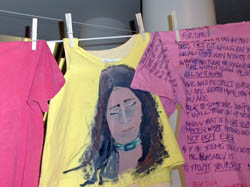
The shirts of the Clothesline Project hang like just-washed laundry in the TSC’s Sunburst Lounge.
They are covered with marker and paint – confessions of lives scarred by domestic violence. For the survivors, the pictures and text will fade before the haunting memories do, but the shirts provide a voice for those who refuse to live out their lives in silence, said Janet Osborne, director of Utah State University’s women’s center.
A 21-month-old girl has scrawled black lines on a small white shirt with a rainbow flower stitched into the chest – her depiction of abuse.
In paint on a green T-shirt, someone has written: “At 6 I learned to read and survive father rape. He built me a tree house and sodomized me. ‘You act normal, or else.'”
A few feet away, a blue shirt hangs on the line. It is torn is in several places. The marker print reads: “I was 5. No one protected me. I am 40. I still feel 5. I will survive this. I won’t be silent anymore.”
The Clothesline Project was started 15 years ago in Massachusetts as an outlet for victims of domestic violence, Osborne said. USU followed suit a year later in 1991, becoming the first school in Utah to participate in the project.
“Survivors, family members and friends design the shirts as a means of expressing themselves and their experiences,” she said. “Some of the designs are very graphic. And some people feel quite shocked. But when you’re looking at them, try to remember that this is their voice. It’s part of the healing process.”
All of the shirts represent people currently living in the Cache Valley, Osborne said. “They’re likely people we know.”
The shirts will be on display until Thursday as part of the university’s activities for National Domestic Violence Awareness Month.
Last week, members of the community tied purple ribbons – the designated color for domestic violence awareness – to trees around campus and the community.
Tuesday, Dr. Frank Ascione, a professor in the university’s psychology department, spoke to students about the connection between animal abuse and domestic violence.
Ascione said people who abuse animals are more likely to engage in domestic violence.
In one of his studies, he said 5 percent of women who were not victims of domestic violence claimed their husband or boyfriend abused their pet, while 54 percent of women who were abused cited violence against animals in their home.
While Ascione’s research is among the first to explore the issue in depth, he said the connection between violence against animals and humans was being discussed in the 1700s.
Many questions regarding the motivation of animal abuse have yet to be answered, Ascione said.
“That’s the next step,” he said. “In most of our studies, we interview the victims and often, we don’t ask questions about motivation.”
In animal abuse cases, Ascione said the abuser sometimes forces the rest of the family to watch the violence. Ascione shared a story with those in a attendance.
“A man bludgeoned the cat in front of the family,” he said. “Then he put the dead cat in the 4-year-old’s bedroom. He took the 4-year-old by her hand and put her in the room with the cat. He then locked the door and left the girl in the room overnight. In the morning, she was required to clean up.
“I can’t imagine the terror she must have felt.”
Ascione said children in violent homes often depict abuse against animals when asked to draw pictures of abuse in their homes.
“Children who grow up in homes with domestic violence may be more prone to aggression,” he said. “Some may develop a greater sense of empathy.”
Void of healthy relationships with their spouses, Ascione said victims sometimes form bonds with their pets – a bond that may cause some problems for women seeking shelter.
“There may be a significant number of women delaying going to a shelter because of what could happen to their pets. Obviously, it’s an obstacle that needs to be overcome.”
More and more, Ascione said, domestic violence support groups are trying to accommodate victims with pets. Locally, the Cache Animal Shelter has a foster-home program for pets, he said.
Wednesday, Robert Cook, a local psychologist, will discuss male victims of domestic violence. Osbourne said she’s excited for Cook’s presentation because it’s difficult to find a professional with a background in male victims of violence. Cook will speak in the Sunburst Lounge at 11:30 a.m.
-acf@cc.usu.edu