
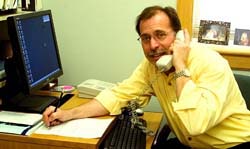
Hard-working professor not too busy for students
Lisa Mills found out how dedicated her U.S. national government and politics professor Peter Galderisi was when she asked him for help on an assignment. What impressed Mills was that the project was for another course.
“I thought it was really neat of him to take some time to help me with a project that wasn’t for his class,” said Lisa Mills, a junior in public relations. “He was a big help.”
Galderisi, a long-time political science teacher at Utah State University, always finds time for students despite a hectic schedule.
“Peter’s level of dedication to students is unequalled,” said political science professor Michael Lyons, who has known Galderisi for 24 years.
Truth is, Galderisi enjoys his play time as much as working, adhering to George Herbert’s statement (found on the political science department’s home page) “Living well is the best revenge.”
“You kind of live a little bit large once in a while just to basically feel that you’ve accomplished something,” Galderisi said, adding that whatever he’s doing, “it’s go full-throttle.”
Galderisi, in his frenzied New Yorkese, said he is almost doing more than he “can actually handle, but [he’s] getting it done one piece at a time.”
This includes research projects, finishing a political and social statistics textbook, reviewing grants for the National Endowments for the Humanities, teaching two-and-a-half classes this semester and more. And he has so many other ideas that he wants to develop that’s he’s applying for a sabbatical later this year.
Although some students may believe that a sabbatical is just a prolonged vacation given to tenured professors, Galderisi said a sabbatical is vital for research and coming up with new ideas.
“I’ve never had time to get any of these new ideas off the ground,” Galderisi said. “It’s kind of killing me because you kind of chomp at the bit.”
These new ideas include studying election systems in foreign countries, among other things. But Galderisi, who drives to Logan from his Salt Lake City home every other day, spends so much time on committees and finishing books and articles and teaching that there doesn’ t seem to be enough hours in the day for him.
“He works as hard as anybody I’ve ever known in the teaching profession,” said Michael Lyons, political science professor and 24-year friend of Galderisi.
Lyons said last week’s Iowa caucus, in which Sen. John Kerry’s surprise win over John Edwards and Howard Dean left pollsters and pundits reeling, forced Galderisi to rewrite two lectures completely.
ACADEMIC FREEDOM
The recent debate over an academic bill of rights may be even more relevant in the political science teaching profession.
Galderisi generally takes the view that “a professor conducts the class the way he or she feels the class should be conducted” with some obvious limitations.
While Galderisi admitted that it’s impossible to teach with absolutely no bias, he said he likes to play the devil’s advocate in order to get his students to think about why they have their beliefs.
That’s why he usually takes the liberal side of the argument – his audience at USU is largely conservative.
But things were different in California.
“While I was teaching in Santa Cruz, the Young Republicans asked me to be their faculty adviser,” Galderisi said.
Whether he’s taking a liberal or a conservative view, Galderisi understands politics so well that he seems to be both fascinated and disgusted by the whole game.
He admires good politicians not for their ethics, but for their strategies. Also, the shouting matches disguised as political debates shown on news channels are growing tiresome for Galderisi.
“The news … is just getting more and more vitriolic,” Galderisi said. “I can hardly turn on the TV without people just screaming at each other, and I find that very distasteful.”
A cherished political quote hanging on his office door reveals his true feelings.
“The spirit of liberty is the spirit which is not too sure that it is right” comes from a 1944 speech by Judge Learned Hand, and Galderisi believes more people should adopt this attitude.
“It’s kind of my belief that even if I think I have strong beliefs, I have to at least have partial consideration for the point of view that I might be wrong,” Galderisi said. “There might be another point of view that is even more valid.”
Galderisi, who said professors should be able to control what they teach, said there are some things that go too far, such as racism and sexism. Racism was merely an abstraction until he went to some small towns in North Carolina.
Having gone from Ithaca, N.Y. to Chapel Hill, N.C. to Logan, Utah, some people ask him what it’s like moving to a small town. Galderisi said that’s the wrong question to ask, because those other places were small towns. Also, people just assume Logan is the most conservative place he’s lived. Wrong again.
“I found Utahns to be much more open than say, a lot of people I ran into in North Carolina, who wouldn’t deal with me because I had an Italian last name,” Galderisi said.
The experience that really opened his eyes also happened in North Carolina. Galderisi said he was walking down a narrow curb by a muddy street and an elderly woman was walking toward him. .
“Before I even had a chance to think about it, she jumped into the mud,” Galderisi said. “I couldn’t understand it until someone said, ‘was she black?'”
He learned that “her training” was to submit to whites, although he was a young college kid and she was an old lady.
“I would say that’s probably one of the most memorable … experiences I’ve ever had in terms of culture change,” Galderisi said.
Galderisi noted that great progress has been made since the early 1970s and racism is much less prevalent in the South, where it had been most prominent.
INTERESTS
Galderisi loves traveling partly because when he was growing up in Spanish Harlem, “traveling was going to Jersey.”
Now, because his wife is a trainer for Delta Airlines, he has seen Greece, Italy, Germany and other European countries many times.
One nice thing about Italy is Galderisi can get a good bottle of Brunello for a third of what it would cost in the U.S. He has what he calls a “moderate wine cellar” with about 40 bottles of aging wine.
“I’m not one of these people you’re going to see in ‘Wine Spectator’ with the cigar and the shelves behind him,” Galderisi laughed. “But you know, once in a while, I don’t hesitate to buy a $75 bottle of wine to store it for five or six years.”
His eyes glowed as he spoke about one bottle he bought in Italy in 2001.
“That’s the one I open when I retire.”
Also when traveling, Galderisi believes one should “taste what the culture has to offer.”
PASSION
Galderisi is almost frustrated by the lack of time and resources he has to start his project ideas.
For example, he has done some research by contacting people to see what motivates them to vote. He wants to see if he can apply the same logic to other countries. But he said it’s a logistical puzzle to find out how to do that type of experimentation in those alternate voting systems.
He wants to find out “simple things like: Are there centralized voting records? How easy is it to contact people on the phone? How easy is it to contact people by knocking on doors? Will government try to interfere with you? Do you have to get political parties involved?” Galderisi asked as the hypothetical questions all seemed to shoot out of his mouth at the same time.
He said background must be done before even setting up a field experiment.
Even with the opportunity to have students in the Dominican Republic, and colleagues willing to help, Galderisi still couldn’t get the project off the ground.
“I just didn’t have the time last semester to do the groundwork,” Galderisi lamented.
But a sabbatical would allow him to focus more time on such projects.
The projects he most enjoys are those in which he works with students.
“He especially excels working individually with students on projects,” Lyons said.
Mills mentioned Galderisi was passionate about what he taught.
“He was very energetic in his teaching style,” he said.
Galderisi’s passion for politics is evident in his teaching, but the big picture is to get students to think analytically. His view of pedagogy is to present both sides if they exist, and to try not to stress which side he’s on. But, Galderisi reiterated that if he does take a side, it will be the opposing or minority view.
“I think that part of teaching is challenging people. And part of challenging people is getting people to think about what they believe in,” Galderisi said. “And not to change those beliefs, but to get [students] to understand why they have them, or what the implications of them are.”
Galderisi holds that if everyone had the point of view that their point of view might not be right, then political debates would be resolved more peacefully. And that’s just what Galderisi wants.