
Thinking outside the bubble
Study abroad trips can be a great way for students to enrich their education. In addition to study abroad opportunities, USU has a very ethnically diverse staff, which allows Aggies to expand and enrich their international education without ever leaving campus.
Professor Brad Hall, head of the language, philosophy and communication studies department, said diversity of faculty is beneficial to students and allows them to gain perspectives on global issues as well as a deeper understanding of culture students wouldn’t be able to achieve otherwise.
“The diverse faculty helps students get a better feel for different ways of looking at the world,” Hall said. “If a faculty member is international, they have perspectives on global issues that others would not.”
Hall said the exposure of students to faculty members that have lived and worked in other countries is helpful to students, adding to an international experience. Thirteen of the 37 faculty members in the language department are natives of other countries. Hall said most of those thirteen received their doctorate degrees in the U.S. and have been in the country for at least five years.
“Our faculty does a very good job,” Hall said.
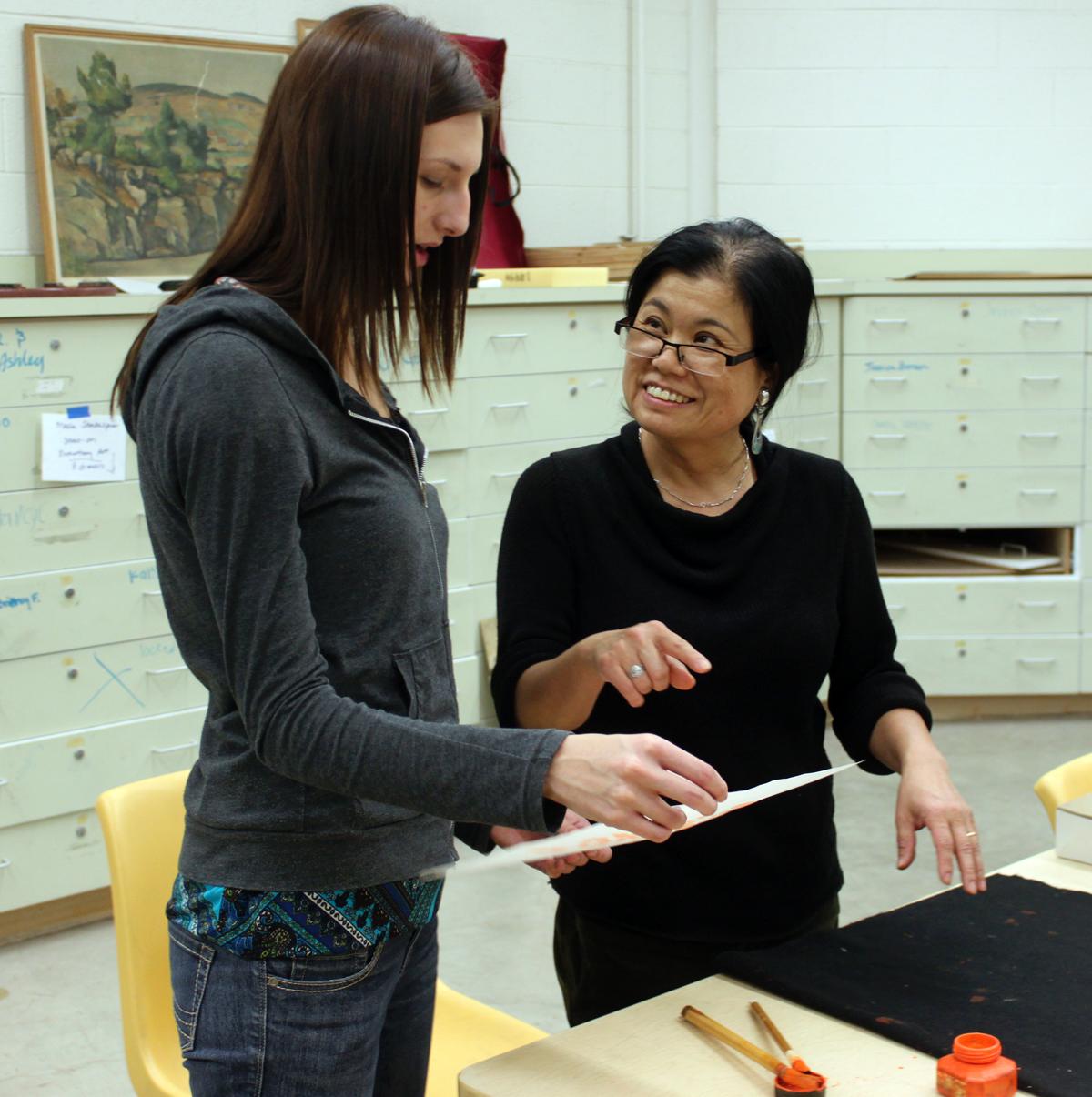
Atsuko Neely, a native of Japan, is currently in her 21st year as a professor at USU and teaches upper division Japanese classes, as well as culture and calligraphy. Neely said she feels an international experience is an exchange rather than a one-sided concept.
In addition to international staff and students being brought to Utah State, American students and staff also go to other countries. Neely said this exchange promotes cultural understanding in all countries affected.
Neely’s husband is a native of the United States, and she said in spite of differing backgrounds their families share very similar value systems.
“My philosophy is that a major difference between two individuals is greater than a cultural difference, in spite of a great ocean,” she said.
Neely said the cultural diversity which she and other international faculty members have to offer is of benefit to students.
“Living in a remote area, the university provides a great deal of authentic experience for students,” Neely said. “If you have a live person in front of you it’s the best example – better than a book. You actually feel how they are like in other countries because you’re coming into contact with someone.”
Like others might when experiencing a new culture, many faculty members have a new perspective on American culture upon their arrival to the United States.
“It came as a surprise that there was privacy here,”
said Adele Cutler, a statistics professor. “In New Zealand, they posted our names and grades in the paper. My grandmother found out my grades sometimes before I did.”
Cutler was born in England and grew up in New Zealand. She came to the U.S. in 1983 and has been on USU’s faculty since 1988. She said she has had a positive experience in Cache Valley.
“I like Americans – they are very receptive to foreigners, especially in Utah,” she said. “There is no animosity toward foreigners. What is cool about Cache Valley is that the beauty is as good as I could ever see in New Zealand, but it’s also a good work environment.”
Cutler said the open display of firearms shocked her, as in New Zealand not even the regular police carry them. She said there were many cultural differences in things such as language, clothing, food and music.
“For everything that I miss, there is something in America that I would miss as well,” she said. “The most difficult part of all is being away from family.”
Jessica Palmer, a freshman majoring in social work, is enrolled in Cutler’s statistics class and said it has been a positive experience for her.
“I think it has been interesting to get a different perspective on things,” Palmer said. “She has different stories to tell because she’s getting her knowledge from both New Zealand and the States. I think it helps.”
When taking a class where a country’s culture is involved, Palmer said she would rather take that class from a professor who is from that country.
“They have more real-life experience,” she said. “They have lived in that country and been immersed in its culture.”
Crescencio Lopez Gonzalez, a native of Mexico and professor of Latino urban literature, said the personal experiences he has had enrich his lectures and provide answers to questions students might have.
“I have lived that reality, and therefore I’m able to enrich the experience of the student,” he said.
Lopez said the information portrayed in books, television, documentaries and media discourse does not always paint the whole picture on some of the subjects he teaches. He said as an international professor, he is able to offer these perspectives to students through firsthand experience.
“I’m not just talking from the books, but I am also bringing personal knowledge that cannot be portrayed sometimes in books,” he said. “You fill in the blanks about how and why a character does what they do.”
Lopez said the teaching between him and his and students goes both ways, and as they learn from each other, he is able to better relate to his students and meet their educational needs. He
said this two-way relationship has changed both him and his students.
“As I am teaching them, they are also teaching me about their culture,” he said. “They’re teaching me about their experiences and how they see the world. They get the best of me, and I also open up to them. It has been a learning experience that has already begun to change me. I hope I have begun to change my students too. I know I have because I feel it.”
– calewp@gmail.com
@Calewp