

Autistic children get language training from USU students
A room filled with theories, interaction models and learning strategies – and you never thought pre-school could be this fun?
Autism Support Services: Education, Research, and Training (ASSERT) is a Utah State University-based program offering pre-school 20 hours a week to 3- and 5-year-olds.
Not only has ASSERT opened the door for pre-school aged children to be integrated into their kindergarten classes, it has also slipped a foot in the door for three USU graduate and four undergraduate students to have hands-on experience with children with autism.
“No two children with autism are the same,” said freshman Julia Goepel, majoring in psychology.
A part of USU’s College of Education and Human Services, ASSERT provides a research facility for innovative “educational interventions” as stated in the ASSERT information pamphlet.
The foot nudging the door open last fall belongs to assistant professor Thomas Higbee, who is ASSERT’s program director. He started at USU and saw the need in the area for a program like the ones he had worked in during his graduate studies.
“There was a need in Cache Valley,” he said.
Immediately, he began working with faculty and staff at USU to open a facility that would offer assistance to families with autistic children.
“Dr. Higbee has the best of both worlds, the clinical experience and in-home visits,” said doctoral student and co-assistant director of ASSERT, Kara Reagon.
“Seeing progress drives my interest,” he said.
The program itself resembles the ones he has experience with. Goepel is a tutor for ASSERT, working one on one with each of the four children completing what’s called discreet trials. They involve giving verbal commands to a child and then reacting according to the response.
“For instance I can say, put the block in the bucket, and then he or she will have three possible responses to that command,” she said.
Of the three responses the correct is the most desirable but the other two are if the child doesn’t respond at all or they respond incorrectly. She will prompt the child by a series of physical tapping, such as hand-over-hand placement of the block, then touch of the elbow, then the shoulder, until the physical prompts are phased out and the child can follow the verbal commands correctly.
“My son is always saying ‘teach me more,’ with his actions and progress,” said Lisa Warren, mother of a 3-year-old enrolled in ASSERT.
She said it’s a “huge, huge positive.”
“[Autism] is a spectrum disorder and so the characteristics of [each child] are different,” Goepel said.
Success is measured over time and it’s wonderful, Goepel said, to see the tiny changes and improvements every day.
“It’s been proven that this type of program is successful for children with autism,” Goepel said.
Higbee has a vested interest in the program’s focus of preparation.
“Our goal is to make these children successful for integration into their kindergarten classes,” he said.
Children with autism can be successful in a classroom of children who do not have autism but they learn in very different ways.
“A child with autism cannot sit still and watch the teacher for a long period of time, or the students,” Higbee said. “It takes a lot of hard work and different resources for them to be successful in that setting.”
Family support is critical to the success of the program and that is why two home visits are required per month and why parents are encouraged to visit and help out in the daily classes with the children.
“I’ve worked with children with autism for seven years and while working in a home-based program it sparked my interest,” Higbee said.
With a handful of graduate and undergraduate students working with four enrolled children, many more applications are currently under review, and children are being added to the waiting list as called in by families. Higbee is excited for the program to continue and is focused on the financial needs of ASSERT.
“At this point our primary goal is funding,” he said.
Reagon said, “We need to get more funding so we can accept more children.”
Parents do pay a weekly rate and the program is looking into getting some other grants.
The program has taken off and Goepel is grateful for the role of the parents in it and the experiences she’s had with the children.
“It’s what [parents] can do at home that counts,” she said.
-ireneh@cc.usu.edu
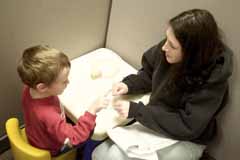
Julia Goepel, a USU psychology freshman, plays a guessing game with Conner at the ASSERT center, Wednesday. Conner, an autistic child, has been in the program since May, when he could only say one word at a time. Today, Conner can say complete sentences. (Photo by Aaron Hogan)