
Natural learning environment
Nestled between an icy cold river and mountains whose high cliffs are blanketed with snow, a small building sits peacefully.
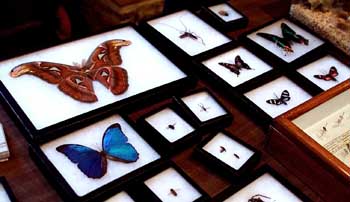
It’s a home to animals, insects, fossils and an atmosphere where teaching is the key.
The Stokes Nature Center, an easy driving distance up Logan Canyon, celebrated its sixth anniversary Saturday with activities for all ages. Little
naturalists were intrigued with talk of weather, reptiles, amphibians and insects, and entertained with nature games, hikes and crafts.
A short hike to the nature center from the road reveals a glimpse of what Logan Canyon has to offer -the crisp cool air, white frosted pine trees and patches of snow dotting the rocky trail are just some of the experiences.
The center’s mission is “to provide opportunities for students of all ages to explore, learn about, and develop appreciation and stewardship for our natural world,” according to The Dipper, the center’s monthly newsletter.
“Get away from a rigid program; allow things to develop spontaneously; that’s the most effective way to teach in nature,” said the late Allen Stokes, founder of the nature center, in a pamphlet.
Stokes and his wife Alice, deemed as incredible educators by Janna Custer, executive director of the nature center, contributed a lot to the community’s understanding of and appreciation for the natural world.
The center, once the American Legion Lodge, is open year-round with frequent organized activities dotting the calendar. Peak times are in the late spring and summer, Custer said, with
winter programs relocated to schools throughout the valley. This year the center made its first contract with Cache County School District for ongoing programs in its schools.
Beyond school programs, the center also offers summer youth programs, family and community programs, Custer said, which have included Predator Ecology, Winter Safety Series, Tales and Trails, Aquatic Insects, and Geology of Logan Canyon; and a volunteer naturalist program, which provides training and teaching experience.
The center is continually growing. Currently, Custer said, the Center has around 200 members.
“Student fees cover only a fraction of the cost to provide hands-on nature education. Our programs are funded directly by contributions from individuals and foundation with a passion for education, youth and the natural world,” according to the membership pamphlet.
Member benefits include a one-year subscription to the Center‚s newsletter, discount to most programs, and free admission or merchandise discounts at participating nature centers nationwide, according to the membership pamphlet.
“Helping support a great organization,” Custer said, however, is the number one benefit of membership.
The Center has a great relationship with Utah State University’s College of Natural Resources, Custer said. That’s because it’s where many of the Center’s volunteers come from. The Center only has six staff members, so the volunteers play a huge role.
The public is free to come from 10 a.m. to 4 p.m. on Tuesday, Wednesday, and Friday and from noon to 4 p.m. on Thursday, and from 9 a.m. to 5 p.m. on the second and fourth Saturday every month, or during scheduled events.
Upcoming events include solstice party , avalanche awareness, a snowflake version of Tales for Trails, a winter safety workshop and a family snowshoe adventure. Dates and times can be found on the Center’s Web site, www.logannature.org.
-jlkarras@cc.usu.edu
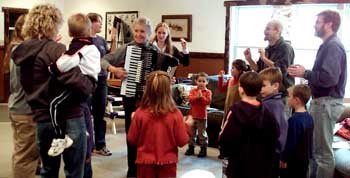
Paula Watkins, playing the accordion, leads the Chicken Polka as part of the entertainment at the Stokes Nature Center annual open house Saturday. (Photo by Michael Sharp)
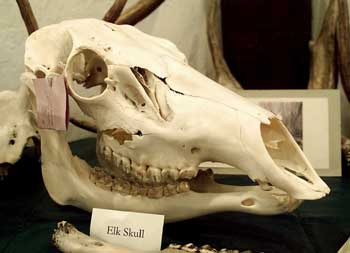
This elk skull gives a smiling grin as it sits on display at the Stokes Nature Center (Photo by Michael Sharp)