
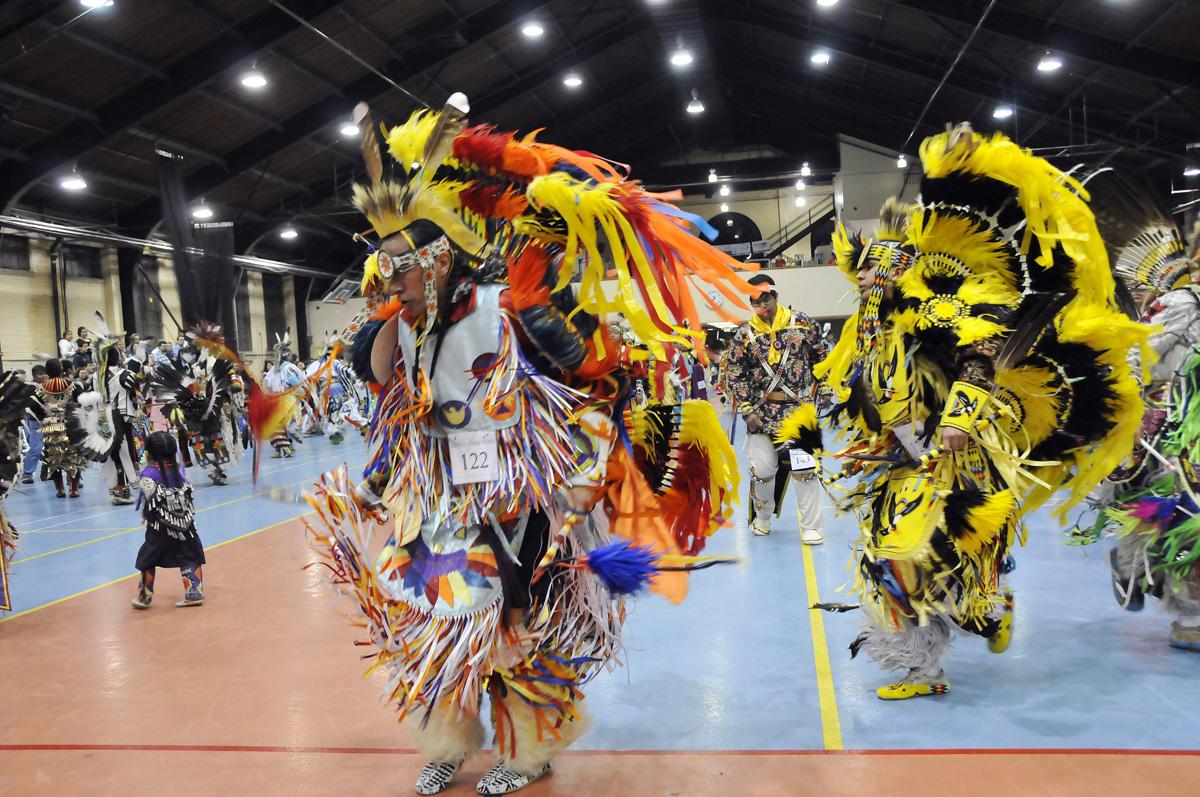
Powwow familiarizes community with historic traditions
Members of the USU Native American Student Council (NASC) held its 39th annual “Echoing Traditional Ways,” with powwow dancers and drummers competing in the Nelson Fieldhouse.
Nathan Chee, a resident of Salt Lake City who said he is originally from Omaha, Neb., said he enjoyed the environment of the event. “I’ve been around it before, but I don’t come here often. It draws me here because I grew up with this stuff from my mom and dad, but I’d always stayed away from it, so I decided to come check it out again.”
Dancers compete in various categories depending on age and gender. According to NASC’s website, the drum groups are “the sacred heartbeat of the powwow, setting the rhythm of each dance.”
The “Grand Entry,” according to the site, is the first dance of each powwow, and the competition element was added to the powwow around 1920. The dancers are judged on dance skill, regalia, sportsmanship, and body and footwork.
Shirley Reeder, who has participated and helped run the event for many years, said the NASC is associated with USU and has always been run in the Fieldhouse.
“Everyone loves that floor,” she said of the floor in the Fieldhouse. Of USU’s powwow, she said, “It’s been around quite a while.”
“This event being the first kickoff for the powwow season,” Reeder said. “It’s a really good turn out.”
She said she and her husband originally lived in Oklahoma, but after they got their teaching degrees at USU, ended up staying in Logan. “I’m elementary and he’s secondary,” she said. “I teach sixth grade and he’s a junior high physical education teacher.”
She said there were people from Fort Duchesne, Wyo., Wind River Reservation, Fort Hall, Idaho, Salt Lake City and southern Utah who had come to attend.
“It’s about our heritage,” said Britny Hardy of Salt Lake City. Hardy and Chee, her boyfriend, sat in the eating area during a portion of USU’s powwow event. Chee said he has been around events like the powwow his whole life but had often avoided it.
“I don’t come here often, but I decided to check it out again.” Chee said his Mom and Dad raised him in the tradition.
Reeder said Cache Valley is a beautiful place, which makes it a great place to hold powwows. She said she feels Logan is almost isolated.
“The serenity, the beauty. It’s away from city life,” she said. “People here are more country living people. They’re down-to-earth people. Everybody loves it here because it’s beautiful, peaceful.”
She also said the weather is ideal and serene in Cache Valley. “Winter’s are great. They are harsh, but they are great. And summers are awesome here.”
She said they had always heard about they beauty and serenity of Logan, and when they were accepted to USU, they were happy to be enrolled at a University in such a beautiful location. “We’ve raised our kids here and we all love it,” Reeder said.
She said powwows make her happy and always touch her heart.
“I almost cry because I see all the young kids coming in as teenagers. They choose to be here, the Native American teenagers,” she said. “They could be out doing drugs or something, but they choose to be here.”
Reeder said she has had some opportunities to speak for her community and culture. “I’m always grateful, when I speak, I’m always grateful for their parents to take the time.” She said beading an outfit is certainly not easy and making the outfits is not an easy task either, but she said she is dedicated, as well as the other participants.
“We raise all of our kids in the arena and we’ve taught them how to respect the arena and respect the elders,” she said. “Dance for them. Don’t dance for yourself. Don’t dance for the money.”
“I think they’ve grown that spirituality that people recognize,” Reeder said people have recognized how beautiful her children are on the floor. “That’s kind of like the soul of our powwow people,” she said. “We could see that they love this. My husband and I both try to teach them ‘Don’t do it for the money.’ We tell them to ‘Do it for your grandparents — dance for them, be proud of who you are.'”
She said it can be difficult when the children become teenagers, “They say, ‘I don’t want to dance no more,'” but when they have the opportunity to see other kids their age, she said, “It brings them back.” Reeder said the focus of the arena is to “only take good thoughts in there.”
“It all revolves around good energy and thoughts,” she said.
“It’s powerful out there, very powerful. Even if (a non-Native American) goes out there, you just feel the energy and the drums tell it. It’s like our heartbeat.”
She said she is from Tiwa and her husband is from the Wichita tribe.
“It’s the heartbeat of our powwow, our soul.”
– natashabodily@gmail.com