
There’s more to food than taste
He came to Utah State University in August 1984 as what he calls “a trailing spouse” for his wife’s job, and it was quite a culture shock for him.
“Boy, it’s hard to get a beer,” said Charles “Chuck” Carpenter, head of the nutrition and food science department, about his first impression of Logan, laughing. “Because I grew up in Wisconsin with a lot of Germans, so beer and sausage were a fact of life.”
Amazingly, Carpenter does not have a degree in food science. He has a bachelor’s degree in biochemistry and master’s and doctorate degrees in muscle biology and meat science, all from the University of Wisconsin at Madison.
At USU, he first spent three years with post-doctoral research for the food science and the biology department.
“During that time a faculty member of the [food and nutrition science] department left for industry and the position was advertised, so I just applied for it,” he said.
In his 17 years at USU, Carpenter worked his way through all the professorial ranks until he became the interim department head a year and a half ago after the retirement of Von Mendenhall. He was named department head in August 2003.
“The NFS department is one of the most productive and recognized units at Utah State,” said College of Agriculture Dean Noelle Cockett in an interview for Utah State Today in 2003. “The continuation of this legacy will be greatly facilitated by Chuck’s appointment as department head.”
Despite all the extra administrative work as a department head Carpenter still tries not to neglect his research. His main interest is the relationship between muscle biochemistry and meat quality.
“I’ve always tried to make that link between muscle biochemistry and physiology and the nutritional and food value of meat,” he explained.
But he can still enjoy a good steak or sausage, he says with a smile, even despite all his knowledge about the ingredients and production of meat.
Also, his favorite leisure activities are not too far away from his daytime job. He likes to bird hunt with his two dogs, a Labrador and a Chesapeake, and fly fish when it’s not bird season, he said. And when he comes home with his prey, he is also in charge of the cooking.
“Cooking is sort of a hobby for me,” he said. “I do all the cooking at home.”
But even though he loves cooking, he also stresses that food science is much more than that.
“A lot of people think that food science is just cooking,” Carpenter said. “We actually have a lot of specialty classes where you develop your culinary skills in that program. But food science is more applying physics, chemistry and biochemistry than just working with food.”
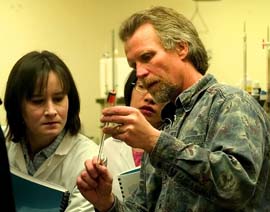
However, besides being a researcher and department head, the thing he still loves most about his job is his role as a teacher.
“I do love teaching and it’s something that I continue to do as a department head,” he said. “It’s great because of the students and their energy and the interaction with them.”
He also says that he didn’t really notice a drastic change in student behavior over the two decades he has been teaching. The big change was rather the difference between student life in Wisconsin and Utah. He experienced a different culture attitude at USU because of the large number of married students with families and their strong commitment to their religion.
“You know, here obviously, students have commitments [other than school] and have to get that balance of school work and other life commitments in a lot of ways that I never had to when I was going to school,” he said. “So I think it does make a different culture here as far as teaching.”
However, it seems he adapted well to the student culture at USU, at least according to his students who like his well-structured teaching.
“I’ve worked with him a lot and I think he’s an excellent instructor,” said Karin Allen, Carpenter’s teaching assistant and graduate student in food science. “I think he does a really good job making concepts accessible to people and he’s very, very well-organized.”
Carpenter’s will to constantly improve his teaching is also greatly appreciated by his students.
“He does evaluations of himself consistently, he’s very interested in feedback,” said Taylor Rasmussen, a senior in food science. “Everything he does is for the benefit of his students.”
-mattpetry@cc.usu.edu