
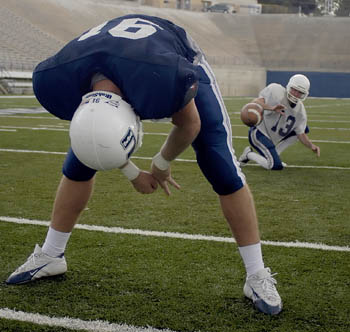
Getting it down PAT
Field goals and extra points should be a walk in the park, but rarely do they turn out that way.
Last year Oregon State’s kicker Alexis Serna missed three extra points in one game and the Beavers lost 22-21 in overtime. Florida State kickers tend to miss wide right, but some things just can’t be explained.
“You should never miss a kick when the hold is perfect,” Utah State place kicker Jarod Jakubiak said.
“Its always the holder’s fault when a kick is missed.” Jakubiak added.
The problems of the kicking game are reflected in most recreational football games where extra points are either omitted and the whole seven points are given or two-point conversions are the only option.
In order to bypass the problem, here is how to consistently execute an extra point or field goal.
Everything begins with the snapper. Jeff King, the Aggies’ snapper for kicking plays, said the snapper doesn’t have to worry about blocking – his only job is to get the ball to the holder. With Brian Soi and E.J. Reid on either side, he doesn’t need to worry about getting bowled over from the rush, he said.
To snap correctly, first hold the laces in your dominant hand as if you were going to throw the ball normally. Put the lace side of the ball facing the ground and bring your other hand on the smooth underside of the ball. Put your middle finger on the seam, in the middle of the ball, so your hand acts as a guide for the snap.
The Aggies don’t use a certain count, King said, but once the holder is ready, he puts up his hand signaling for the snapper to go whenever he’s ready. When snapping, make sure to keep your head down, he said.
The ball should make it to the holder, who should be about seven yards behind the snapper. When snapped and if done correctly, the laces on the ball should already be facing the goal posts, kicker and emergency holder Justin Hamblin said. With the laces on either side of the ball, the kick tends to drift to that side, Jakubiak said.
Once you position the laces, you can put the ball down and hold it with the pointer finger on your back hand, which would be the left if the kicker is right footed. It all depends on the kicker for the little details. Jakubiak said he likes the ball pulled in tighter to the body of the holder.
The holder can also adjust the trajectory by leaning the ball forward or back so the ball leaves at a lower angle for headwinds, or for a higher angle to protect against the kick being blocked.
Once the holder gets the ball down, it’s all the kicker’s responsibility to boot it through the uprights.
“It’s all about the angles and where your plant foot is,” Jakubiak said.
From where the ball will be held by the holder, start lining the kick up with your hips square to the target and your plant foot 10 inches to the side of where the ball will be. Jakubiak said he takes three easy steps back and two shoulder-width steps to the side to get the needed distance for the approach.
Once the ball is snapped and the holder catches it, the kicker starts in planting his foot where he had it lined up and kicking the ball off the top inner part of the foot, right off the bone, Hamblin said.
When crosswinds play a factor, the kicker may adjust his aim a little to the left or right, but the rule is to never aim outside the uprights, Jakubiak said.
As for fake field goals, the holder is usually the one that carries the play out -whether it be passing or running. Jakubiak has suffered two concussions: One on a blocked kick that he picked up and the other on a blown fake he ended up catching.