
Seismic Research
While most people fear the effects earthquakes can have, one Utah State University trio spent the summer drilling into a seismically active fault zone to find answers to what happens when the Earth begins rumbling and shaking.
Geology professor Jim Evans, using his life-long interest in exhumed faults, spearheaded the San Andreas Fault Observatory at Depth project, which created the first subterranean earthquake observatory within in an active fault.
Through months of drilling and in conjunction with team members from Texas A&M and St. Louis University, the group crossed the fault line in early August.
“As it turns out, there’s a lot we don’t really know about how earthquakes work,” Evans said. “We would like to use the understanding we get from this to better deal with earthquakes when they happen.”
Not to be confused with trying to predict earthquakes, Evans says this observatory center is for research and to gain a better understanding of how earthquakes work and what happens at the core of the action.
This 13,082 foot-long drilling project will allow Evans and others to study core samples of material, both rock and fluid, plate movement and stress conditions under which earthquakes occur. Located in Parkfield, Calif., about half-way between San Francisco and Los Angeles, Evans spent part of his summer with two of his students, Kelly Mitchell and Sarah Draper, observing the drilling process.
The drilling process is an extremely delicate one, Evans said, with a multitude of operations falling into balance.
“Things can go wrong quickly,” he said.
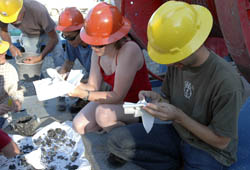
Spending two months of her summer in the sweltering heat, Draper said she “couldn’t pass up a chance to work on the San Andreas Fault.” Most of Draper’s responsibilities fell into collecting samples, photographing them and updating the SAFOD Web site.
“We had to keep the office running, any type of grunt work that had to get done,” Draper said, adding she was surprised how interactive the lead scientists were with the interns. “The big honcho scientists guys were working alongside even the lowest guy on the totem pole.”
This experience not only helped Draper advance her passion for geology, but also exposed her to other cultures. Working alongside with students from around the world, Draper, a graduate student studying structural geology, said she felt a “great spirit of cooperation in this project.”
Mitchell echoed Draper’s enthusiasm for the project.
“It was a really good opportunity,” said the USU senior majoring in geology. “I learned a lot about the drilling process.”
Mitchell says she hopes the data taken from the observatory will shine more light on plate movement and the processes that happen miles below the service in a seismically active area.
Information taken from SAFOD may help with development of an early warning system, Evans said.
Scientists debate about what happens when an earthquake begins, whether it will stay small or if there is a trigger that can change a small quake into a big one, Evans said.
If that is the case, some believe within the first 30 seconds of an earthquake information signals can be sent out to infrastructure systems, such as pipelines, to shut down.
“That’s a big thing,” he said.
The San Andreas Fault, spanning from San Francisco to San Diego, is where the Pacific Plate and North America Plate move back and forth parallel to one and other, thus creating earthquakes. This site was chosen because of the seismic activity, Evans said, which experiences earthquakes of small magnitudes – between two and three on the Richter Scale – every 12 to 18 months.
After core samples are taken, which will happen primarily in 2007, Evans said this is when his work really begins.
Evans will study and analyze rock samples to understand what the chemical properties are and possibly shine light on what happens to the rock when an earthquake occurs.
Evans gained funding for this project through the National Science Foundation and is in conjunction with Earthscope, an organization that uses telecommunication, analytical and observation technologies to better understand the structure of the North American continent.
With material analysis beginning in 2007, Evans hopes his project will continue on until 2008 or 2009. More information about SAFOD can be found at www.earthscope.org.
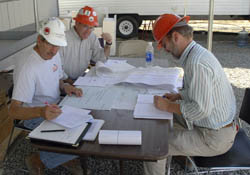
Utah State University Geology Professor Jim Evans discusses some of the data with two other geologists on site. Evans, using his life-long interest in exhumed faults, spearheaded the San Andreas Fault Observatory at Depth project, which created the first subterranean earthquke observatory within an active fault.