
Free riders wanted
Staff and students concerned with air quality in Logan have organized a program called Aggie Blue Bikes through which students can check out free transportation that is both healthy and good for environment.
Students can borrow the blue bikes starting Sept. 1 to commute around campus and Logan. Those who borrow are responsible for the bikes and will be required to sign a waiver releasing Aggie Blue Bikes from any liability. Adam Christensen, a student at USU and one of the masterminds behind the program, is in charge of bike-lending.
“We’re totally excited,” he said. “We can see this making a big difference in the community.”
Bikes will be checked out at the Utah Conservation Corps, located between the Military Science building and the Fieldhouse on 700 North. With a student ID, students can borrow bikes for up to a month and will be responsible for maintenance, repairs and thefts. The system works “just like a library,” said Christensen.
Christensen has been working with Sean Damitz, Utah Conservation Corps director, and Kevin Kobe, Campus Recreation director, for the past year to get this program on its feet.
Christensen said he has devoted 30 hours in the past week to getting the system and the bikes up to speed. Not only is he the bike lender, he is in charge of getting funding for the program, and is also acting as a mechanic – fixing up and painting bikes bright Aggie blue.
Five of the 10 bikes were donated and the others were purchased. Donations came from Rob Hamlin, a local bike repairman, and Juan Franco, vice president of Student Services at USU. Franco donated money to the program. Christensen said he also hopes to work with the campus police to turn abandoned bikes on campus into Aggie Blue Bikes.
Set up to organize the program, the student-faculty committee also worked with the police department to change campus policy concerning bikes. Bikes were prohibited on campus during peak hours of the day, but the policy was unenforceable. The campus police were very willing to help change the rules, said Damitz.
Christensen said he hopes to have twice as many bikes by January, and as many as 60 next fall.
“This program is still in the womb,” he said. “Every day that goes by, progress is made.”
The idea of the blue bikes came from Kobe, who heard about community bike programs in other cities and thought it could be a solution to air quality problems. Last fall students asked for a system through which they could borrow community bikes and Joyce Kinkead, vice provost for undergraduate studies and research, helped put the idea through to the right people.
Community bike programs in other areas have failed, said Christiansen and Damitz, because the system used is best described as a “free-for-all.” Bikes are left outside campus buildings and whoever wants to can take one and leave it at their destination. No one has responsibility for the bikes and no one keeps track of them. The committee came up with the check-out system as a way of knowing who to hold responsible for the bikes.
Along with the bikes, information on riding safely and considerately will be distributed. Some students on campus are not in favor of allowing the bikes on campus because of the past conflicts between riders and pedestrians. Aggie Blue Bikes is working on introducing bike lanes to campus keep traffic flowing safely.
-ella@cc.usu.edu
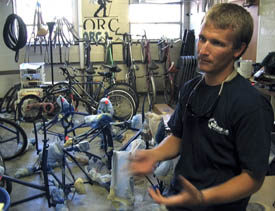
Adam Christensen discusses some of the details and workings of the Aggie Blue Bike program. Students will be able to sign out bicycles to ride around the city or campus starting Wednesday morning. (Michael Sharp)