
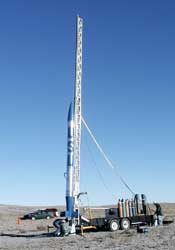
Reaching new heights
Utah State University’s mechanical engineering rocket project “Chimaera” is winning competitions and will continue to attain great achievements in the future, officials say.
In a competition earlier this month between USU and the University of Alabama-Huntsville, the first rocket built for the project, Chimaera, reached a height of 5,700 feet and flew 15-20 seconds, said USU adjunct professor Paul Mueller, who oversaw the project.
The competition took place near an old army launch site near Green River, Utah.
The rocket was constructed entirely by current and past mechanical engineering students, he said, and was made for educational objectives.
The purpose of the project is to give engineering students hands-on experience in designing, building and launching a rocket, Mueller said.
David Omer, a mechanical engineering graduate student, said the program was named by a previous senior design team after a fire-breathing mythological hybrid creature called a chimaera. The propulsion system of the rocket, launched Jan. 5, was a hybrid, consisting of solid rubber and liquid nitrous oxide, he said.
“Making a hybrid rocket is no easy task,” Shannon Eilers, senior design team leader, said.
The rocket, which weighed about 450 pounds and was about 25 feet long, reached a maximum speed of approximately .08 times the speed of sound and produced about 3,000 pounds of force for four to five seconds, Omer said.
The recovery system, which was supposed to bring down the entire rocket in tact, malfunctioned, causing the three parachutes to deploy about four seconds too late. When the shoots didn’t initially open, the engineers on the ground sent a signal to the rocket to deploy them, but by then, the rocket was going fast, he said. The force caused part of the body to break off and plummet to the ground unrestrained, Omer said.
“The force of the shoot opening at that velocity caused catastrophic failure of the air frame,” Omer said.
UAH’s recovery system also failed, Omer said. At the conclusion of the event, the exact height the rockets reached was undetermined and USU won the competition based on their levels of professionalism and student involvement, Omer said.
USU’s rocket was constructed entirely by students, from the motor to the launch rail, he said. Every team member was well-acquainted with the rocket.
“I really feel this has been one of the most valuable experiences I’ve had at USU,” Omer said.
While much of the rocket was damaged in the crash, the onboard data chip survived and is currently being analyzed, Omer said. It has since been concluded that UAH’s rocket went higher, reaching approximately 11,000 feet.
The January competition was an outgrowth of a rocket project called Unity 4, which was a collaborative effort between USU, Brigham Young University, University of Utah and Weber State. The group has since dissolved because of infrequent launches, Mueller said. The future goals of the rocket program, he said, are to have annual competitions and get universities in Utah involved again.
The current USU design team is rebuilding a rocket, Eilers said, and one of the USU rocketry program’s goals is to build a rocket in such a way that future launches could reach altitudes of 200,000 feet. They are also trying to get funding for nozzle research, he said.
Mueller said he hopes to invite elementary, junior high and high school students during the making of the rockets to get them excited about science and math and to use the rockets as a recruiting tool. He also said he would like to invite the public to launches to illustrate how fun rockets can be.