
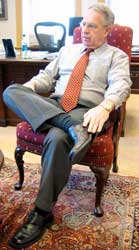
Behind the scenes
Stan Albrecht wishes there were more hours in the day.
As president of Utah State University, his list of important daily tasks may seem daunting at times.
“My days go from early in the morning to late at night,” Albrecht said.
But after conquering his first year as president, he remains grateful for the opportunity.
“It’s been an excellent year,” he said. “I still wake up every morning and feel humbled and grateful to be president of Utah State University. I think we’ve made a lot of progress.”
After President Kermit Hall left Cache Valley more than one year ago to become the president of the State University of New York at Albany, former provost Albrecht took the reigns as USU’s 15th president and faced a whirlwind year of expected and unexpected events.
“Being president is enormously complicated,” Albrecht said looking back.
From enrollment decreases to a 15-passenger van accident that killed eight students and one faculty member, Albrecht has led the university in a critical year of transition.
“He seems to be doing a good job. He has had many issues to deal with his first year, like the terrible van accident, a new library, residence hall and performance center and students angry about tuition hikes. He has really dealt with a lot this year and handled it well,” Johanna Carling, a senior majoring in political science, said. “I am sure he is working very hard, but his work is not apparent to the student body because we do not see it.”
Enrollment decreases
Among some of Albrecht’s work behind the scenes is House Bill 66. Almost immediately after accepting the position of president in February 2005, Albrecht began working on the bill, which will provide 400 out-of-state tuition waivers to students living in Idaho who wouldn’t otherwise be able to come to USU. The bill was passed last week during the Legislative session, said Lee Burk, assistant to the president for government relations.
“It paid off,” Albrecht said. “It was about as good as we could have done.”
The minute the bill was passed, the university sent post cards to all potential Idaho students, informing them of the tuition waivers available. Aside from sending post cards however, Albrecht, administrators and faculty members have visited one-on-one with potential students and their parents in Pocatello, Malad, Preston, Layton, Provo and Sandy by means of the Road Scholars Tour to offset the decline in enrollment of 780 students fall semester 2005.
“It’s about carrying USU’s story to communities throughout Utah,” Albrecht said. “We’re hoping this will pay off in the fall but this is not a one-year fix, this will take a couple of years.”
Whether or not enrollment will increase, many students, parents and teachers were still impressed with the Road Scholars Tour.
“The interaction that the students had with the professors was really uncommon,” said Malad High School Principal John Cockett.
Provost Ray Coward has been working with enrollment since he began in January and is very optimistic.
“Our numbers look good, but we still have some critical months ahead of us,” he said. “We have a good story to tell, this is a good education that students get at USU and it’s an affordable education.”
Van accident
The university was also faced with the unexpected 15-passenger van accident in September that brought statewide and national attention.
“That’s the kind of event that no one ever plans for,” Albrecht said. “The most difficult part about it was sitting down with a young wife who was recently married and telling her that her husband died.”
The accident began an extensive review of the university’s vehicle-use policy and resulted in permanently discontinuing the use of all 12-and 15-passenger vans.
“Without exception, USU’s handling of that event is viewed in an enormously positive light,” Albrecht said. “I think people came to understand us better.”
Albrecht said some people might even enroll at USU because of the way the university dealt with the accident.
“I was very impressed with how he handled the tragic van accident this fall,” Carling said. “He really reached out to the families of the victims and handled the grief of our campus with class and compassion.”
Listening ear
Aside from the accident, many faculty members have been impressed with his continued compassion and concern for the welfare of the university.
“He always listens and deeply considers what the faculty is saying,” Faculty Senate President Derek Mason said. “He is a thoughtful person, is willing to listen and provides carefully considered feedback.”
ASUSU President Quinn Millet works closely with Albrecht and knows what he is worried about in terms of the student body.
“Working with [President Albrecht] is great; he really does care about student issues,” Millet said. “He makes sure we’re working towards the same objective.”
Since Albrecht started as president, he has held a luncheon each month with various students throughout campus. He asks them questions and tries to resolve any concerns they may have.
In terms of the Legislature, Burk said Albrecht is very effective with the legislators because he’s honest and believable.
“The legislators believe what he tells them and he listens to them,” Burk said.
But Kyle Waters, who graduated in December in government and technology, said although Albrecht is more in touch with the students, faculty and the community than past presidents, he could still be more sensitive to the students’ concerns as well.
“Students don’t know that much about [university] issues because they don’t feel
like they can do anything about it,” he said. “The faculty and board can and have vetoed things we want.”
Carling said she has been unhappy with Albrecht’s lack of interaction and involvement with the students.
“He hasn’t really been out there listening to the needs and concerns of the students,” she said. “Does he know that we worry about how to pay our tuition and rent and still get decent grades while juggling several jobs? Does he know that we worry about finding jobs in the future and providing for our families with the education we receive here?”
The future of USU
But Albrecht said he hopes to improve the university by making USU available to everyone and providing an affordable but quality education.
“We need to build on an excellent foundation that is already in place.”
He hopes to expand the university system by improving the continuing education sites throughout the state, making USU available to a broader population.
“I can see the growth of a very robust program,” he said.
In addition, Albrecht hopes the university will receive funding for the Utah Science, Technology and Research (USTAR) initiative that will expand the economic possibilities throughout the state by teaming with businesses to increase research.
“It’s an investment in higher education,” he said. “This is a marvelously important step in higher education.”
-mmackay@cc.usu.edu