
Tibetan ritual reaches USU
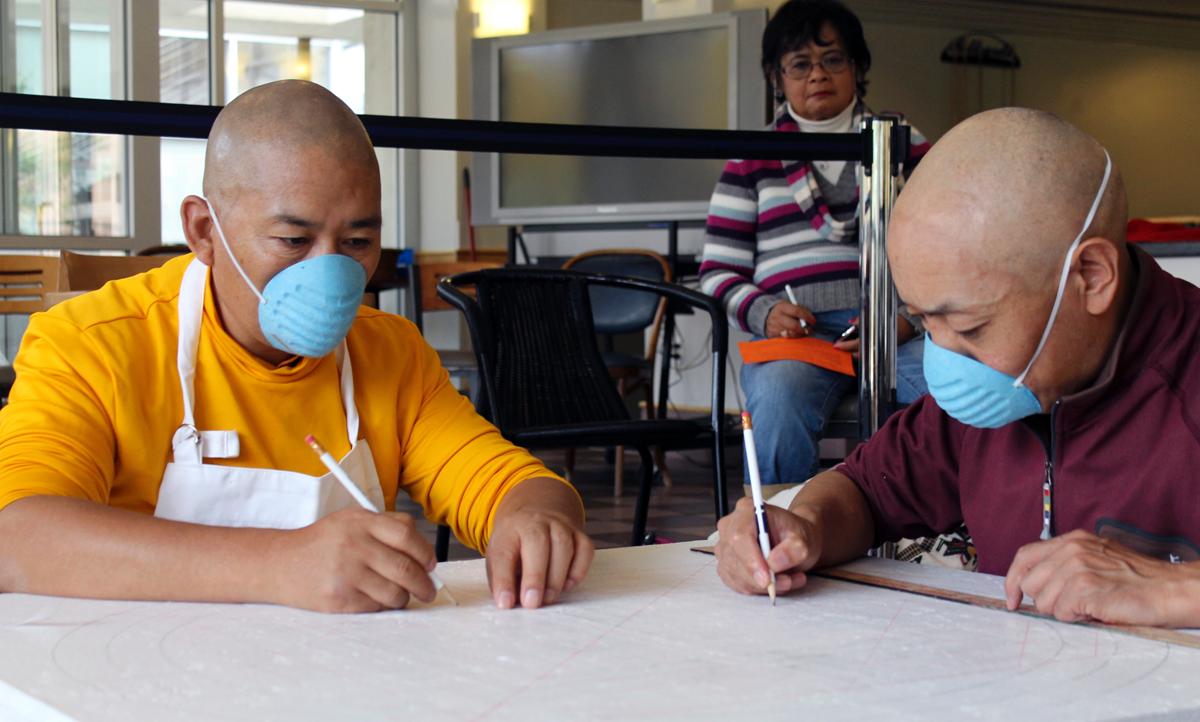
During the week of Oct. 21, Venerable Sonam Karushar and Khenpo-la, Buddhist monks from Tibet, accompanied by Dr. Hun Lye, professor of East Asian studies from Davidson College, will be creating and destroying a sacred sand mandala in the Taggart Student Center.
Khenpo-la, a resident of Pittsburg, became a monk at 40 years old and has been a part of the construction and destruction of mandalas numerous times. He has mostly created them with Sonam Karushar.
Karushar lives in Boston, and 1979 had to make a choice between marriage and becoming a monk. He decided to become a monk.
The mandala Sonam and Khenpo-la are creating this week is a compassion mandala.
“We bring compassion,” said Khenpo-la. “Compassion deity is our inspiration.”
Karushar said Utah State will produce many world leaders, and they seek world peace and harmony. This focus on peace and harmony is reflected in the mandala being constructed representing compassion.
“The construction of this sand mandala is a part of experiential learning,” said Dr. Wijitha Bandara.
He said students usually read about the ritual, and the mandala is a great opportunity for students to learn about one of the many religious art forms in Asia.
Pete Wosnik, a senior majoring in history and religious studies, said he was especially impressed with the beginning of the event.
“It was a very neat event,” he said. “They did some religious rituals with some chanting, some bells and a drum. It was really interesting to watch.”
Bandara said this whole project will enlighten students on an ancient yet still thriving sacred form of Buddhist art in East Asia and will enrich the partial knowledge students have concerning this ritual.
Dr. Hun Lye said the sand mandalas represent sacred cosmologies, divine energies and spiritual principles.
“Mandalas can be created in many ways – painted, sculpted, visualized, and more recently, digitally,” Lye said.
“The mandala is an ancient Tibetan art form depicted with colorfully dyed, delicate sand arranged on a surface with painstakingly calculated geometric patterns and architectural lines,” Bandara said. “It represents the cosmic view of Tibetan culture blended with Buddhist philosophy and rituals that aim to confer physical, psychological and environmental healing and blessings.”
Wosnik said he is excited to see the mandala in every stage of progression.
“I’m excited to see how tedious and intricate the designs are,” he said.
The BBC website said once the mandala is complete, the monks ask for the deities’ healing blessings during a ceremony. As the monks chant, one monk begins the destruction of the mandala by scraping a knuckle through the sand, creating a cross of grey sand.
The cross is created in the sand, at which point another monk takes a paintbrush and slowly, carefully sweeps the sand from the perimeter to the center of the mandala. The destruction of the mandala serves as a reminder of the impermanence of life, according to the BBC.
The BBC site said once the sand is swept to the center of the mandala, it is then placed into an urn and subsequently poured into flowing water, which is meant to represent an extension of healing powers to the whole world.
“The coloured sand is swept up into an urn and dispersed into flowing water, a way of extending the healing powers to the whole world. It is seen as a gift to the mother earth to re-energize the environment and universe,” according to the BBC.
Khenpo-la said the destruction of the mandala is a very interesting.
“The part is a benefit for other beings,” he said. “The mandala brings real benefit to the oceans, animals and goes to the whole world. So it brings peace – our prayer goes everywhere.”
“I think that holds deep spiritual significance for them,” he said in regards to the destruction of the mandala. “They don’t try to hold on to it. They let it go when it has finished its significance.”
Dr. Philip Barlow, the director of the religious studies program at USU, said they brought the creation and destruction of this mandala to USU due to the importance
of the study of religion.
“The study of religion is important, whether or not one construes oneself as religious, because we need to understand the cultures we encounter,” he said. “It helps to think about what a full-blown and disciplined religion is. The construction and dissolution of the beautiful sand mandala can help us witness and understand something of the Tibetan way of symbolizing the cosmos and our relation to it. It is an unusual opportunity to be able to host this week-long event.”
The mandala is to be constructed throughout the week. It began on Sunday with an introduction about the creation of the mandala. On Monday, the grid used to complete the mandala was laid down. From Tuesday to Thursday, the mandala will continue to be constructed, and it will be destroyed on Friday at Second Dam.
A film, “Himalaya,” will be shown on Tuesday at 7 p.m. at the Hub, at which time Lye will give a lecture entitled “Mandalas – Circles of Awakening: The Meanings, Uses, and History of Mandalas in Buddhism.”
– carli@jdsco.com
Twitter: @Carli_sue