
USU reaches students with disabilities
Utah State University has new technology to help people with disabilities.
TypeWell is a program designed for hearing-impaired students so they can participate in classrooms more fully. The program works with two laptops that are connected wirelessly. One student, a transcriber, types the lecture, questions and comments and the hearing-impaired student reads the discussion on his computer.
This program was designed because of the lack of ASL (American Sign Language) interpreters. The transcriber is specially trained to use a code for typing, said Diane Hardman, director of the Disability Resource Center.
Actually, TypeWell has been around for awhile, but not many people, especially faculty, know about the program, Hardman said. There will be an Assistive Technology Fair on Tuesday from noon to 2 p.m. in the Taggart Student Center Ballroom. The purpose of the fair is to create awareness of new technologies that make learning easier for people with disabilities, she said.
“If faculty are aware, they can make it easier on students with disabilities,” Hardman said.
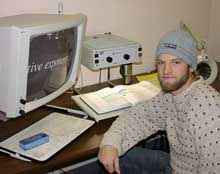
Currently USU uses CCT, closed caption television, for students with sight impairments.
This essentially is a large magnifying glass that can make the words high-contrast, which is white words on a black background. CCT monitors are located in the Disability Resource Center (DRC) and the Science and Technology and Merrill libraries.
“I rely heavily on it,” said Shaun Williams, who has a degenerative disease in his retinas and can’t read small print well.
JAWS (Job Access with Speech) is a computer voice output program that reads text aloud. This is also helpful for students like Williams. PDF files are not readable by these programs and have to be reformatted, usually to rich-text format. Many online files, like supplemental instruction and syllabi, are PDF formatted.
Even The Statesman isn’t readable to many students, although the online version can be formatted to be used by voice output programs.
Making files readable for these programs “requires cooperation from a variety of entities, like the library and the bookstore. The faculty needs to anticipate the needs of students,” Hardman said.
So far, the DRC hasn’t run into any serious problems with faculty. Most faculty are very understanding and willing to help provide the best learning environment possible, she said.
“We have a really good faculty. They’re very used to having our students,” Hardman said.
New technology is being experimented with all the time. Some is still in the work-in-progress stage, she said. For example, there is a new device that will caption video clips automatically – without the need of a human transcriber. This will also be showcased at the fair Tuesday.
“[This new device] would help most students if video clips were captioned, especially deaf students in distance education programs,” Hardman said.
The DRC has been using talking calculators and talking dictionaries for some time now. They even have FM systems that will connect right into hearing aids, so as the professor uses a microphone, it cuts out all the background noise and the student can better hear the lecture, Hardman said.
The DRC is also working on updating its own technology, and starting next semester, all books will be put on CD instead of tape, she said.
All students who go through the DRC for assistance must provide medical documentation of their condition, Hardman said.
“We only help those who come to us. We don’t go looking for [students],” she said.
-gmk@cc.usu.edu