
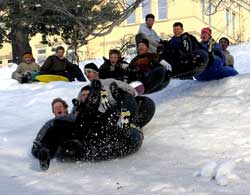
Life at the speed of snow
Between blizzards, canyon winds and the inversion, Cache Valley winters are not for the faint of heart. Students, as well as members of the community, are forced to look for a silver lining in the dark cloud that is the Cache Valley winter, and many find it on Old Main Hill.
Matt Jemmett, a student at Utah State University, is one of those people.
“We are by no means experts, but we have a good time,” he said.
“I was super scared at first, but now it’s like baby stuff,” Kim White, another USU student, said.
But even though the hill is frequented by hundreds of people every winter, nobody really knows when this winter tradition began.
Maren Barnett, ASUSU traditions chair, said things like that really haven’t been documented. “[It’s] probably since the beginning of the university – I mean, it’s a sledding hill.”
Because students are prone to creativity, some pretty strange things have slid down the hill in past years including couches, lunch trays and refrigerators.
“We used to go sliding down on those inflatable chairs a lot. Someone went down once with a couch on skis, but it fell halfway down and kinda just rolled the rest of the way,” USU student Allie Plaizier said.
“We’ve found that a mattress is basically the best way to get a lot of people from the top to the bottom,” Jemmett saud. Along with the occasional mattress, many people take the more traditional route slidding down on inflated inner tubes and all different makes and styles of sleds.
Rachel Winters, a senior majoring in environmental engineering, said this is her fourth winter coming to the hill. “It’s fun when it’s powder, but it’s death when it’s iced over.”
At one time, loose straw served as a barrier between the hill and the street below, but the straw was hard to gather come spring and also killed the grass. USU next tried using bales of hay.
“I think the university put up the bales in the interest of student safety,” Barnett said.
However, there were problems with that method too.
“It would rain and soak the bales, and then they’d freeze, so when you’d run into them it’d be like hitting a brick wall. I mean, you hit them once and you’re not going to again. It hurt,” Plaizier said. Without the barriers, most sledders try to jump off when they start getting close to the cars.
Because of the inherent risks of sledding, there are a number of injuries every year. Jim Davis, Student Health and Wellness Center director, said he’s seen at least fourteen injuries from accidents on the hill since Christmas.
“The injuries range from bumps and bruises to lacerations, fractures, and significant concussions,” he said.
Davis also works one night a week in Logan Regional’s Emergency Room.
“I’ve seen six or seven serious injuries this year, and I’m only one of nine doctors there,” he said. “A couple of years ago when all the snow got pretty icy, we saw two neck fractures. This year has been better because we had a period without any snow, and then this snow has been pretty powdery. I’d say [there are] easily 30-50 [injuries a year]. There’s really no way to tell since no one’s tallied them all from all the different clinics and hospitals throughout the valley.”
The university takes no official action for or against the winter activities except to remove liability for any injuries anyone sustains while sledding by posting warning signs.
“[The signs] don’t lie,” Dale Hunsaker, head of the USU Risk Management office, said. “[Those signs] are there for disclaiming the university and the state, so that people are on their own if they go down the hill.
Possible injury doesn’t seem to deter many hill-goers, though. In fact, the biggest complaint seems to be going up rather than down.
“When I went down the first time, I was scared I would run into a tree. But actually the walk back up was worse,” Bunny Sharp, a freshman majoring in English, said.
-limarc@cc.usu.edu