
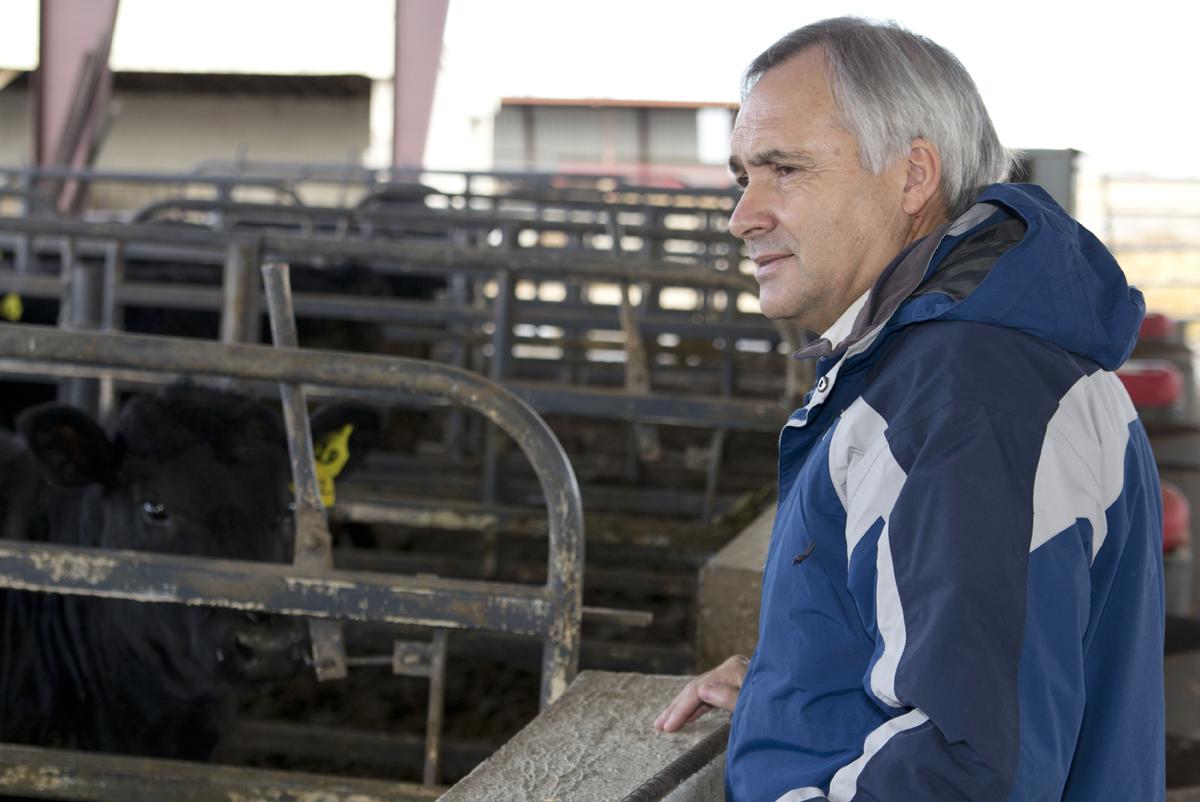
Extension specialist travels world, calls Logan home
Dale ZoBell took a bite out of a hot liver, freshly removed from the belly of a gazelle in Mongolia.
He witnessed an elephant run past him at 20 mph, while he stood outside his door in Nepal. He has slept through a 6.668 earthquake, walked on the white beaches in Australia and climbed the volcano Mount Merapi in Indonesia, three days before it erupted.
In Ecuador, ZoBell worked one on one with the natives. He has seen leprosy, poverty and overwhelming wealth in the same city. Along with Big Ben and the Eiffel Tower, he has beheld and even hiked the Himalayas.
“To see the Himalayas once in your life time, you can die happy,” ZoBell said.
If this was a job description it would be hard to guess the Raymond, Alberta, Canada, native’s actual line of work. One might guess world traveler or humanitarian, but he is neither.
He’s a beef specialist. An Extension beef cattle specialist for USU, to be exact.
ZoBell said he is also the associate department head and professor for the College of Agriculture.
Extension is one branch of USU. The other two are research and teaching. Because USU is a land-grant university, Extension’s purpose is to improve the quality of life for individuals, families and communities. Many of the resources and materials developed at USU will go to countries around the world.
“It’s the best job on earth. There is no better job I have had than working in Extension,” ZoBell said. “It’s like, ‘Wow, I can’t believe they pay me for this,’ because every day is different. You work with people on the land. You can help them remain sustainable and viable.”
ZoBell has traveled to 25 countries, primarily as an Extension beef specialist, to increase their capacity to develop and deliver Extension programs. He said he’s also there to help solidify their research programs.
“People in third-world countries have a very positive opinion about the U.S. academic system,” ZoBell said. “They very much want faculty from U.S. institutions to visit them in a capacity-building relationship. They want to publish in international journals but are unsure how to do this. In many cases, we assist them to validate their work in Extension and research. Research collaboration is also highly desired.”
Noelle Cockett, who is the vice president of Extension and the dean for the College of Agriculture, said she’s found ZoBell to be a great asset.
“Dale has several research collaborative projects with other faculty in the College of Agriculture. These projects are improved because of his involvement,” Cockett said.
In Nepal, ZoBell and Robert Gillies, a state climatologist at USU, are involved in a seed grant in which they have partnered with Helen Keller International to understand how climate change could influence livestock production.
“The water that the Nepalese use doesn’t come from the Himalayas. They get most of their water from the monsoons. Depending on how the monsoons change as far as intensity and delivery then their farms are affected by what they can produce. If they have just enough to food to feed themselves, they won’t feed their animals very well,” Gillies said.
It is Gillies and ZoBell’s hope that through their research they may gain a better understanding of the Nepalese livestock practices and the climate they live in. If they can understand that, they can prepare and educate the people for circumstances when the water precipitation changes, Gillies said.
“Many of these projects are integrated, using expertise in different areas to address the real life situation. In this case, farms,” Gillies said. “We wouldn’t be able to do this project without Dale. Bottom line. Dale has sort of a wry sense of humor. The people we worked with seemed to really get along with him. His humor or sarcasm — don’t know if they caught it — but it worked really well.”
ZoBell found his experience in Nepal to be an adventure.
“Nepal, it’s like ‘Alice in Wonderland.’ I can’t really tell you. You’ve got to see it, hear it and taste it. It’s just different,” ZoBell said. “It’s like I just saw an elephant, then there are monkeys and then you’ll see a Mercedes-Benz. Then you look up and you see the Himalayas. Solid glaciers. Just knocks you clean right over. Nepal has the poorest people on earth and the nicest kindest people on earth.”
As long as ZoBell is working with the land and the animals, he is comfortable wherever his job takes him.
“I like being on the land wherever I am in the entire world,” he said. “My international work takes me to countries where I can see opportunities to help people, but remain in my specialty area and understand production on an international scale. My main job is working with the farmers and ranchers in Extension.”
The research he conducts brings about validity and recommendations for ranchers who are then able to apply his findings with their livestock. ZoBell works primarily with nutrition and management and has developed materials such as fact sheets and booklets on beef cattle production and management.
ZoBell’s services to the school go beyond his work in the classroom. As of now, he has assisted in raising $2.3 million in grants for USU. These grants were generated through collaborations with faculty as well as a $525,000 donation from ZoBell’s friend.
All ZoBell has achieved and the sites he has seen don’t even come close to rivaling one thing, he said.
“I’ve been married for 40 years. Five children and 12 grandchildren. As much as I love Extension, it doesn’t touch a candle to my grandkids,” ZoBell said. “That’s my greatest accomplishment. Nothing I’ve ever done or will do will compare to my family.”
– kristi.j.lambert@aggiemail.usu.edu