
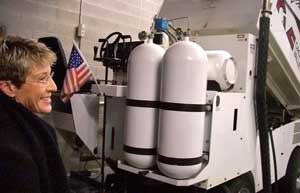
“i wanna drive the zamboni”
Christine Hardy has a job that everyone wants.
She gets to drive the Zamboni.
“It’s fun,” she said. “All the kids want to see you. At first I was terrified. Now, it’s just a job.”
The Zamboni machine is the vehicle that resurfaces the ice at rinks, making it shiny and smooth. It comes out for every intermission at hockey games.
The Zamboni machine is named after its inventor, Frank Zamboni. He invented the contraption in 1949 as a way to resurface large sheets of ice in a short amount of time. Frank was born in Eureka, Utah, but invented his famous device in California.
The mechanics of the machine are more complicated than most fans think.
The Zamboni looks like an overgrown riding lawnmower that’s dragging a big metal box behind it. This big metal box is called the conditioner.
Inside the conditioner is a large blade.
“It’s a single-edge blade, like one you’d shave your face with,” Hardy said. “I don’t know exactly how heavy it is, but it takes two people to pick it up.”
This blade shaves the top part of the ice off. A horizontal screw inside the conditioner scoops up the shavings and moves them to a vertical screw that shoots the snow into a big tank at the front of the Zamboni.
The conditioner then cleans the ice.
“It shoots out fast, jetted water, ” Hardy said. “A hose sucks it back up. This fills in little holes in the ice.”
After the ice is cleaned, the conditioner drops 160-degree water onto the ice.
“This becomes the new surface of ice,” Hardy said. “A rag drops behind it and pushes the water into all the grooves and smooths it.”
Hardy said it is important that very hot water is used.
“When water is frozen, the actual molecule is closed,” she said. “The hot water sort of opens it up and forms one solid piece of ice. If you put cold or just tepid water on it, it would just freeze with air in between the old ice and new ice. It would chip as soon as someone skated on it.”
She said this is why pond ice is never quite as good as rink ice.
“It’s not like the pond, where you just run the hose over it,” she said. “I think that skaters that learned on a pond are better because the surface is so bad.”
Hardy said the ice can be kept at different temperatures. She said the colder the ice is, the faster you can skate on it.
“[The EIC] is at 21 degrees,” she said. “Figure skaters like it warm, at about 23 degrees. Hockey players like it lower, at about 17 degrees. Speed skaters like it even colder.”
She said rinks have to resurface the ice every two hours if it is being used.
“It’s kind of expensive,” she said. “We have to heat the water, fill it with [natural] gas and pay the resurfacer. People complain about it, but we’re very cheap compared to other rinks.”
The ice is kept cool with glycol and ammonia, Hardy said.
“Underneath the ice is a huge pad of concrete,” she said. “Underneath that is miles and miles of pipe filled with glycol and ammonia. And underneath that is miles and miles of more pipe for a heat floor. That keeps the ice from falling into the ground.”
When the ground freezes in the winter, the underground water turns to ice and the ground expands. This can cause the ice to bulge and then sink when the ground melts. The heat floor keeps this from happening, she said.
Hardy said the thickness of the ice is usually 1 1/2 to 1 3/4 inches, but the EIC is currently at only one-half to 1 inch.
“We’re trying to build it back up,” she said. “We take weekly measurements of hundreds of places on the ice to see where it’s at.”
The rink has a detailed depth chart of the ice surface that shows where the high and low spots on the ice are.
Hardy said there are a variety of different patterns the Zamboni driver can use when resurfacing, but the machine is built to run clockwise around the boards.
“It has a guide-roller to keep it from hitting the wall,” she said. “It has studded tires to keep it from sliding around.”
Hardy said the EIC sells Zamboni driving lessons, but it is possible to be much more educated in the art of resurfacing.
“It’s a huge industry,” she said. “You can get certification at different levels. I got to go to Chicago to train. I got to meet Frank Zamboni, Jr.”
Hardy said driving the Zamboni on a regular basis creates a passion for the ice.
“You’re so in tune,” she said. “You want to make the perfect sheet of ice. That’s the goal, because ice makes people happy.”
-bhhinton@cc.usu.edu
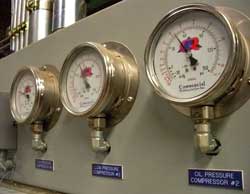
Pressure gauges to regulate the ice rink. (Jessica Alexander)
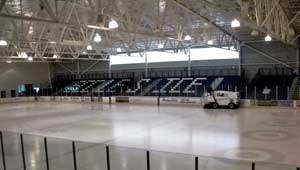
The Zamboni resurfacing the ice. (Jessica Alexander)