
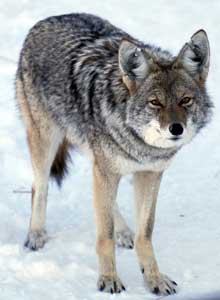
Researchers study Milville coyotes
In a three-story shack in Millville, Sarah Dawson, a PhD candidate at Utah State University, is researching ways to deter coyotes from interfering with livestock.
Dawson, a wildlife biology student from West Virginia, has been working on this project for a year and a half. She said the goal of the project is to find non-lethal methods for decreasing conflicts between coyotes and humans.
“We change the context of human-coyote interaction and find which situations cause the most avoidance behavior,” she said.
Dawson’s experiment consists of putting coyotes in various situations with humans to see how they affect their behavior. In order to gather her information, she must spend early mornings and some nights in the shack, which she calls her second home, observing approximately 20 coyotes, finding out how they react to different situations.
Fred Knowlton, a professor in the wildlife biology department at USU, said coyotes are a problem in the Intermountain West for sheep ranchers. Coyotes are often accused of depredation, or preying on livestock.
Despite their bad reputation, the only coyotes that kill livestock are alphas, which means the dominant male-female pair in their territory, said Mike Jaeger, another professor in the wildlife biology department and Dawson’s adviser. He said Dawson’s project was a spin-off of a study begun in California in 1992 that determined alpha behavior.
Dawson’s project is geared toward steering coyotes away from the places livestock animals graze by using their natural reactions.
“We’re trying to use coyotes’ natural response to humans as predators and exploit that,” she said.
Dawson said there are several other coyote projects at USU’s Predator Research Center in Millville, mostly all focused on behavior.
Dawson’s project consists of dropping food into the coyotes’ pens through feeders. She said it is important the coyotes not rely on humans for food so the experiment simulates conditions in the wild as closely as possible.
At different times before or after food has been dropped into the pen, Dawson will have a human go in. Then she sits and waits to see how long it takes for the coyotes to be comfortable enough to forage or feed.
The findings of the first round of data collection were that if coyotes aren’t allowed to investigate the place where a predator has been, they won’t forage, Dawson said. Jaeger said they are naturally suspicious animals, even ones that have been raised by humans and not mistreated.
In order to be sure there are no mistakes made, each experiment must be repeated several times. Each repetition has seven segments that take about a month and a half each, said Dawson.
Before she began her graduate work she worked on a project concerning cheetah behavior and ecology at the Washington, D.C. National Zoo. She said cheetahs in Africa have the same problem as coyotes in North America.
She said she came to USU to work on her PhD because of the opportunity to study predator behavior.
The USDA is funding the projects at the Predator Center, which was developed in 1972 largely by the efforts of Knowlton, who spent 8 to 10 years working with coyotes in the field. Knowlton said he felt it necessary to have a controlled environment where coyotes could be studied, though it took a while to get people to agree with him. He said many would say the conditions in captivity are too different from the wild to produce reliable data.
“It’s very difficult to study coyotes in the wild,” Knowlton said. “They are a low-density species and very cryptic. They hide readily.”
“It’s a one-of-a-kind place out there,” Jaeger said. “I can’t think of any place like it in the country.”
Jaeger said two important findings have resulted from research both at the research center and in the field. First, it is impractical for ranchers to try to remove coyotes from their land because other coyotes simply fill up the open territory. Second, if coyote control is going to be effective, removal must be specific to only the coyotes that take livestock, the alphas.
Dawson said she was glad for the opportunity to study at the research center.
“We’re lucky here,” she said. “We can control things people in the field can’t even think of controlling.”
One of the things that has proven difficult to control, even in captivity, is the coyotes, Dawson said.
“They will climb the fences,” she said. “It’s always kind of a rodeo to get them back. It takes a lot of people and a lot of hours.”
Despite the difficulties, Dawson said she hopes her research will be beneficial to ranchers and others with livestock, as well as other researchers.
“It’s a new area to look at,” she said. “It would be nice if people could build on it down the road.”
-ella@cc.usu.edu
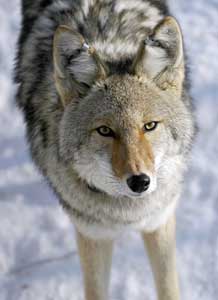
A coyote pauses after running through a snowy field in Millville. (James Schultz)