
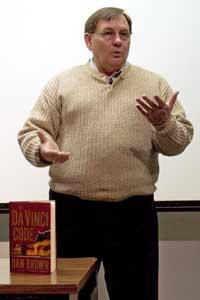
Decoding Da Vinci; Lecturer breaks down novels facts and fiction
Forty million people worldwide read the book, 12 million in North America alone. Published in 2003, the book has sold over 36 million copies in 44 different languages. “The Da Vinci Code”, a fictional novel by Dan Brown has remained on the New York Times Best Sellers list for 155 weeks and in that time has challenged over 2,000 years of history.
Since it’s release, “The Da Vinci Code” has been the topic of numerous debates, dozens of news and television special reports and articles by religious scholars and multiple books written either concurring with, or dissenting of the fictional novel.
Mark Tate, a professor at the Salt Lake Theological Seminary, said the reason for this controversy is found among the first few pages of the book, where Brown explicitly states the novel is fiction, although based on historically accurate facts.
He has worked as a professor at the seminary for 15 years specializing in the history of Christianity and the interpretations of that history.
Tate said it is because this novel claims to be based on fact that such a controversy has sparked as a result.
“It undeniably deserves its superb ratings as a best-selling novel,” Tate said. However, Tate posed the question as to why Brown felt the need to add the controversial statement that his fictional novel is based on fact.
Tate said perhaps he did this to “add intrigue” and create a desire to read it, but Tate said the book obviously needed no enhancement and that statement is in dispute by many contemporary scholars.
Being one of those scholars, Tate said he based his paper on analyzing the factual basis of the claims of the society of the Priori of Sion, the major theme of the marriage of Jesus, the analysis of Hollywood uses of historical fact and determining what is fact and what is true about “The Da Vinci Code.”
Dan Brown states the Priori of Sion is an ancient society which has held the secret of Jesus’ marriage to Mary Magdalen for thousands of years. Tate says there is no actual historical evidence that any part of that is true. He said in 1996, the British Broadcasting Company went to “great lengths” to prove the inaccuracies.
“There is absolutely no historical significance to substantiate these claims,” Tate said, quoting Paul Mayor, professor of Ancient History at Western Michigan State University.
Tate said both Christian and non-Christian scholars agree on the inaccuracies of the references to the Priori of Sion.
Wikipedia, an online encyclopedia, states that, “Most of the evidence presented in support of claims pertaining to its historical existence, let alone significance, has not been considered authentic or persuasive by established historians, academics and universities.”
Tate said there is evidence of societies similar to the Priori existing, but the evidence suggests the society exists in three different forms, in three different time periods; the first record of which was created in 1956, but no group provides any real evidence as to their historical purposes.
“[The information in Brown’s book] is at least a historical stretch and at most, a complete misrepresentation of the evidence.” Tate said.
Tate then went on to explain Opus Dei, including the facts of who and what Opus Dei is as related to the references made in “The Da Vinci Code.”
“The conclusion that we can’t know about the Priori of Sion is taken one step further with Brown’s statements [stated as based upon fact again] about Opus Dei,” he said.
Tate said Opus Dei is a Catholic organization just like any other.
They do not hold any significant financial resources and although there is evidence of coersion and influence held by the group, it is no more and perhaps comparatively less than organizations of similar size.
In the novel, Brown references Opus Dei as a religious group that practices violence, brain-washing coercion, mortification and the villan in the book is depicted lying, drugging and murdering, as directed by leaders of Opus Dei.
This behavior has sparked a recent controversy regarding this group.
Tate said without the influence of Brown’s book, the real controversy about the legitimacy of these acts is minimal, and individuals should “take their evidence from sources and not headlines.”
Tate said Opus Dei does have missions, but are not ordered or required, the organization does not have a hidden agenda of violence and the Vatican is not overly influenced by this organization, as Brown depicts.
On his Web site, Dan Brown states, “I worked very hard to create a fair and balanced depiction of Opus Dei.
Even so, there may be those who are offended by the portrayal. While Opus Dei is a very positive force in the lives of many people, for others, affiliation with Opus Dei has been a profoundly negative experience. Their portrayal in the novel is based on numerous books written about Opus Dei as well as on my own personal interviews with current and former members.”
Tate said the organization is it’s “own worse enemy,” because the organization is private and conducts it’s methods in secret, which gives rights to rumors, implications and accusations. Tate said the leaders of Opus Dei would “admit to the same thing.”
Tate said the amount of fictionalization that Brown created with Opus Dei and the Priori of Sion are not even issues when compared with the amount of inaccuracies and truth that Brown suggests about Jesus’ possible relationship with Mary Magdalen.
“The main cryptic message of the book is of the marriage [between Jesus and Mary],” Tate said. “It is my conclusion that if there are any sources, they have come from a later date and superimposed backward.
This is not a historical approach.”
Tate said there are absolutely no known sources that endorse a marriage between Mary Magedalen and Jesus Christ.
“At best, we do not or cannot go. At worst, this marriage never occurred,” Tate said.
He discussed the upcoming movie, “The Da Vinci Code,” and compared its story line to other historical movies, such as “Troy” or “Braveheart”. Tate said it is important to remember that the characters in the movies may be based on real people, but the stories are fiction.
“The things most memorable are created,” Tate said.
Tate said most religious organizations are not what their founders created, and Christianity is no different. What is important to remember is ideology.
In a nutshell Tate said, “‘The Da Vinci Code’ challenges the positive attributes of Christianity … Some see the plot as accurate regardless of evidence presented or lack thereof. Others will simply assume Brown is in error because they cannot imagine otherwise, again regardless of evidence presented or lack thereof.”
Tate said his conclusions are simple. “If we have no proof Jesus married Mary, then there is no secret for the Priori to protect,” Tate said.
“If we have no secret for the Priori to protect, there is no Opus Dei member out to destroy the now non-existent Priori, out to destroy the now non-existent secret.” He said the novel is nothing more than a thriller that took the names, places and dates of history and used them at will.
FOCUS is also sponsoring a religious panel Tuesday at 7 p.m. to discuss the nature of Christ with BYU Professor Bob Johnson and Pastor Greg Millet.
-etippetts@cc.usu.edu